A trade is the rare baseball decision that comes with a built-in scoreboard. Both teams announce, in real time, exactly what they think a player is worth — and then the next fifteen years tell us who was right. The problem is that contemporaries argued about these deals with the tools they had: batting average, wins, gut feel. We can do better in hindsight, because we have a single number that totals up everything a player did afterward.
That number is Wins Above Replacement. WAR estimates how many wins a player added over a freely available replacement, in one currency, for hitters and pitchers alike. Run the post-trade WAR for the principals in a famous swap and the deal grades itself: whoever’s side produced more wins, won. Here are five of the most lopsided trades in history, scored years later with the benefit of bWAR from Baseball-Reference.
How WAR scores a trade after the fact
The logic is simple. For each player in a deal, add up the WAR he produced after the trade — the value that actually accrued to his new team’s side of the ledger. Compare the totals, and the difference is the margin of the deal in wins. Because WAR puts a 20-game-winner and a slugging first baseman on the same scale, it can weigh a pitcher traded for a hitter without any apples-to-oranges hand-waving.
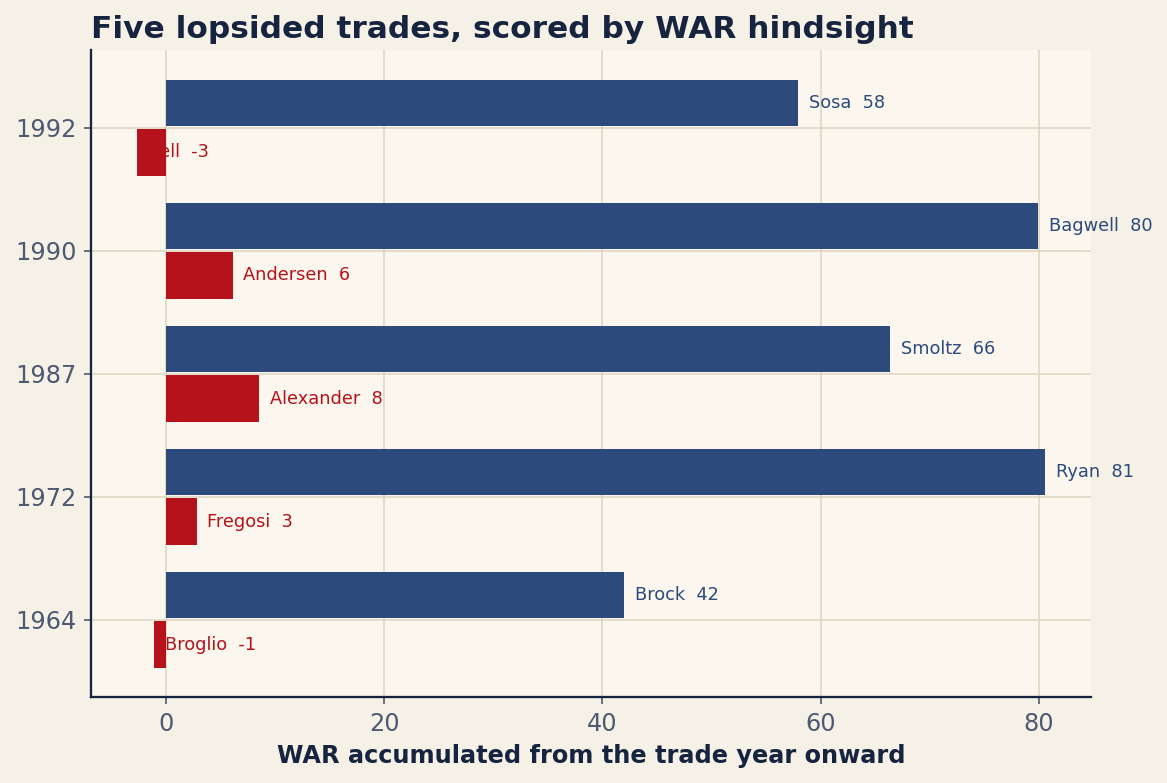
One honesty note on the numbers below. The figures are post-trade career bWAR, so they credit each player for everything he did from the trade forward; in a couple of these deals the player had not yet debuted, so his post-trade total is effectively his entire career. A negative number means a player was, on balance, worse than a freely available replacement after the swap — which, as you’ll see, happened more than once on the losing side of these trades. The chart pairs the two principals in each deal so the gap is visible at a glance.
1964: Cubs trade Lou Brock for Ernie Broglio
In June 1964 the Cubs sent a 25-year-old outfielder named Lou Brock to the Cardinals in a multi-player deal headlined by pitcher Ernie Broglio, who had won 21 games for the Cardinals in 1960. Chicago thought it was buying an ace. Instead, Brock went to St. Louis, became a Hall of Fame leadoff man and base-stealing terror, and helped win pennants. Broglio’s arm gave out almost immediately.
The WAR hindsight is brutal. Brock produced about 42.0 bWAR after the trade; Broglio produced about −1.1 — not just little value, but negative value, worse than a replacement-level arm Chicago could have signed for nothing. What the Cubs gave up was a young, cost-controlled star at the very start of his prime, in exchange for a pitcher whose best years were already behind him. It is the deal every “trade that haunts a franchise” list is measured against.
1972: Mets trade Nolan Ryan for Jim Fregosi
The Mets had a young flamethrower they couldn’t harness and a hole at third base, so after the 1971 season they shipped Nolan Ryan to the Angels in a package for established infielder Jim Fregosi. Ryan went on to throw seven no-hitters, strike out more batters than anyone in history, and pitch into his mid-forties. Fregosi gave the Mets a season and a half of replacement-ish play.
Post-trade, Ryan was worth roughly 80.6 bWAR — the largest single figure in this entire group — against about 2.8 for Fregosi. The Mets didn’t just lose a good young pitcher; they handed away one of the most durable careers the sport has produced, to fill a position that stayed unfilled anyway. Trading raw, high-variance talent for a known quantity is a defensible instinct. It is also how you give up 80 wins.
1987: Tigers trade John Smoltz for Doyle Alexander
This one is the rare lopsided deal with a defensible motive. In August 1987 the Tigers were chasing a division title and traded a 20-year-old minor-league pitcher, John Smoltz, to the Braves for veteran Doyle Alexander. Alexander was magnificent down the stretch and Detroit made the playoffs — so in the short term, the trade did its job.
The long term is another matter. Alexander produced about 8.5 bWAR for Detroit after the trade, which is genuine value for a deadline rental. Smoltz produced about 66.4 — a Hall of Fame career as both a dominant starter and an elite closer, essentially all of it after the swap. This is the cleanest example of what WAR lets us see that contemporaries couldn’t: a deal can be a win in October and still cost you the better part of seventy wins’ worth of pitching value over the following two decades.
1990: Red Sox trade Jeff Bagwell for Larry Andersen
The shape repeats. In August 1990 the Red Sox, in a pennant race and needing bullpen help, traded a blocked third-base prospect named Jeff Bagwell to the Astros for veteran reliever Larry Andersen. Andersen threw 22 excellent innings for Boston that fall and left as a free agent. Bagwell moved across the diamond to first base in Houston and built a Hall of Fame career.
Andersen’s post-trade value to Boston was about 6.1 bWAR over the rest of his career; Bagwell’s was about 79.9, nearly all of it in an Astros uniform. The Red Sox traded roughly eighty wins of a future MVP for a few weeks of relief pitching. As with Smoltz, the excuse is real — contending teams pay premiums at the deadline — but the bill, totaled in WAR, is staggering.
1992: White Sox trade Sammy Sosa for George Bell
In March 1992 the crosstown White Sox sent a raw, toolsy Sammy Sosa to the Cubs for veteran slugger George Bell, a former MVP. Chicago’s American League side wanted established middle-of-the-order production; the National League side took the upside. Sosa grew into a perennial home-run machine on the North Side. Bell gave the White Sox two declining seasons.
Sosa’s post-trade bWAR comes to about 57.9; Bell’s, about −2.7 — the second negative figure on this list, another case of a veteran who was not merely past his peak but actively below replacement after the deal. The White Sox traded a developing star for a name, and the name was already fading. The full table makes the five margins easy to compare side by side.
| Trade (year) | Player acquired → team | Post-trade bWAR |
|---|---|---|
| 1964 | Lou Brock → STL | 42.0 |
| 1964 | Ernie Broglio → CHC | −1.1 |
| 1972 | Nolan Ryan → CAL | 80.6 |
| 1972 | Jim Fregosi → NYM | 2.8 |
| 1987 | John Smoltz → ATL | 66.4 |
| 1987 | Doyle Alexander → DET | 8.5 |
| 1990 | Jeff Bagwell → HOU | 79.9 |
| 1990 | Larry Andersen → BOS | 6.1 |
| 1992 | Sammy Sosa → CHC | 57.9 |
| 1992 | George Bell → CHW | −2.7 |
The bottom line
Four of these five deals follow the same template: a contending team trades a young, unproven, often blocked player for a known veteran who helps right now — and surrenders a Hall of Fame career to do it. WAR can’t tell those teams what they should have known in the moment, because nobody knew Bagwell or Smoltz would become Bagwell and Smoltz. What it can do is settle the argument afterward, in a single honest currency, and the verdicts are not close. If you want to understand why one number can shoulder that much, it helps to know that WAR is assembled differently at each site — a subject worth its own look at how WAR differs by site.
Sources & Further Reading
- Career and post-trade WAR: Baseball-Reference (bWAR, pulled via pybaseball). Retrieved June 2026; computed for this article from that source.
- FanGraphs — an alternative WAR framework for cross-checking the same careers.
- SABR — biographical detail and contemporary context for each trade.