“.406.” “73 home runs.” Baseball’s record book sets these down as bare numbers, stripped of the run environment that produced them, and that bareness hides the most interesting part. The point was never that a player was good. It was that he was good in a season where almost nobody else was doing anything remotely like it.
So this is a list of ten feats measured against their own leagues. They come from nine player-seasons and eight players: Barry Bonds turns up three times, twice for the same 2001, because one season of his produced two separate entries. The individual records are famous — you may already know them — but the point here is the gap between the player and everyone he shared a league with that year. That gap is what makes a performance improbable, and a few of these gaps are absurd.
Why league context is the whole story
A .300 batting average meant something different in 1968 than it did in 1930, because the leagues those hitters lived in were different planets. The honest way to judge a season is to divide what the player did by what a typical player did in the same year — a ratio, not a raw total. A .406 average is impressive on its own; a .406 average in a league hitting .262 is something else entirely.
The table below does exactly that. For each feat it lists the value, the league context that season, and the multiple of league average the player reached. League-context figures come from the MLB Stats API; the records themselves are simply history. Two notes before you read it. All three home-run rows compare a single hitter not to the league’s per-player rate but to an entire average team’s home-run output, which is a different and even more lopsided comparison; we’ll flag them when we get there. And the Hack Wilson row leaves both league columns empty on purpose — the reason is in the section on it, and an empty cell seemed more honest than a number that would have meant something else.
| Player | Year | Stat | Value | League avg | vs. league |
|---|---|---|---|---|---|
| Ted Williams | 1941 | AVG | 0.406 | 0.262 | 1.55 |
| Babe Ruth | 1920 | HR | 54 | 39.4 | 1.37 |
| Bob Gibson | 1968 | ERA | 1.12 | 2.98 | 2.66 |
| Barry Bonds | 2001 | HR | 73 | 181.9 | 0.40 |
| Barry Bonds | 2004 | OBP | 0.609 | 0.335 | 1.82 |
| Barry Bonds | 2001 | SLG | 0.863 | 0.427 | 2.02 |
| Hack Wilson | 1930 | RBI | 191 | — | — |
| Pedro Martinez | 2000 | ERA | 1.74 | 4.77 | 2.74 |
| Aaron Judge | 2022 | HR | 62 | 173.8 | 0.36 |
| Dwight Gooden | 1985 | ERA | 1.53 | 3.89 | 2.54 |
The contact merchants: Williams and the .406 ceiling
Ted Williams hit .406 in 1941, and no one has reached .400 since. The number that makes it improbable is the company it kept: the league batted .262 that year, so Williams was running about 1.55 times the league average. Translate that to a modern environment and you are talking about a hitter clearing .380 in a league that hits .245 — a thing that simply does not happen anymore. Williams did it while walking 147 times, which means pitchers were actively avoiding him and he hit .406 anyway.
The .406 is celebrated as a contact feat, and it was, but the league-relative version is the part that has aged into myth. Hitting is harder than it was, defenses are better positioned, and pitchers throw harder; a 1.55x batting-average season is now closer to physically impossible than merely rare.
The power outliers: out-homering entire teams
Babe Ruth hit 54 home runs in 1920. The improbable part is not the 54 — it is that the average team that season hit about 39.4 home runs total. Ruth, by himself, out-homered a typical roster of his peers by a factor of roughly 1.37. One man produced more long balls than nine other men combined, in a sport where the home run was still treated as a novelty. No statistic in this article better captures a single player dragging the whole game in a new direction.
Bonds and Judge make the same comparison against their own leagues, and the three of them are the subject of the figure below. When Barry Bonds hit 73 home runs in 2001, the average team hit about 181.9 — so Bonds’s personal total came to roughly 0.4 of a full team’s output, not the 1.37 Ruth posted. Aaron Judge’s 62 in 2022 landed near 0.36 of the average team’s 173.8. Those are staggering individual seasons, but the league had caught up to the idea of the home run; nobody in the live-ball era out-homers whole rosters anymore, because every roster is now full of people trying to do the same thing.
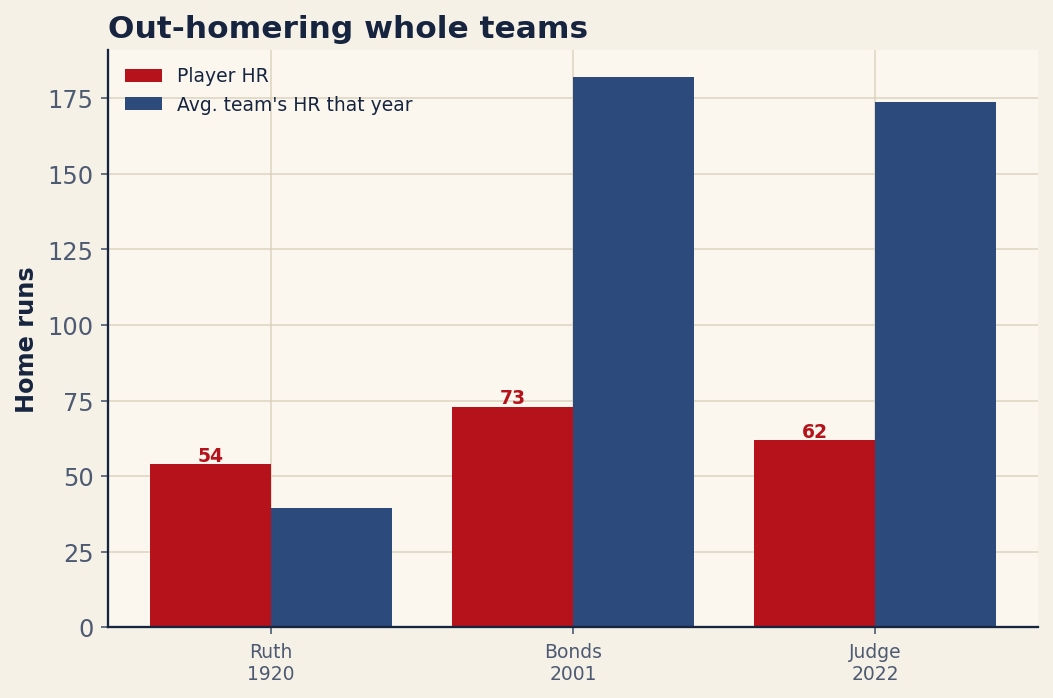
That is the quiet lesson of the chart: Ruth’s bar towers over its league not because he hit the most home runs ever — he didn’t — but because his league hit so few. Improbability is a ratio, and Ruth’s denominator was tiny.
Bonds in a category of one
Bonds shows up three times here, which is itself a kind of evidence. His 2004 on-base percentage was .609 against a league mark of .335 — about 1.82 times league average, a season in which he reached base more often than he made an out by a comfortable margin. His 2001 slugging percentage of .863 ran roughly 2.02 times the league’s .427. An on-base feat and a slugging feat, each roughly double the league, in overlapping seasons, from the same player. Whatever you make of the era, the league-relative distance is unmatched on the offensive side of this list.
The OBP figure is the hardest one to wrap your head around. Reaching base in well over half your plate appearances, in a league where the average hitter does it about a third of the time, means opposing managers had essentially decided that letting Bonds hit was the larger of two evils — and he still posted the highest on-base season on record.
The Year of the Pitcher and its heirs
Pitching has its own improbable seasons, and the ratios get even more extreme because run prevention scales differently. Bob Gibson’s 1.12 ERA in 1968 came in a league that posted a 2.98 ERA — Gibson was about 2.66 times better than his league at preventing runs, in the lowest-scoring season of the modern era. 1968 was so pitching-dominated that the sport lowered the mound the following winter, which makes Gibson’s mark a record that the rulebook itself reacted to.
What we find more improbable still is doing it when the league is hitting. Pedro Martinez ran a 1.74 ERA in 2000, when the league ERA was a balmy 4.77 — roughly 2.74 times better than his environment, in the thick of the highest-offense era baseball has seen. Gibson was excellent in a graveyard for hitters; Pedro was excellent in a launching pad, which is the harder trick. Dwight Gooden’s 1985, a 1.53 ERA against a 3.89 league mark, sits at about 2.54 times league — a 20-year-old turning in one of the great age-relative seasons on record.
The counting-stat monument: Hack Wilson’s 191
Hack Wilson drove in 191 runs in 1930, a record that has stood for nearly a century and almost certainly always will. Its row is the one with no league multiple, and the blank cells are deliberate: runs batted in depend as much on the hitters in front of you as on your own bat, so there is no league baseline for RBI that yields the apples-to-apples ratio the rest of this list uses. Rather than print a number borrowed from a different statistic, the table prints nothing.
What can be measured is how close anyone has come. Pulling the RBI leader from each of the 95 seasons from 1931 through 2025 gives a clean answer: the best is Lou Gehrig’s 184 in 1931, the very next year, and the only other total within ten of Wilson is Hank Greenberg’s 183 in 1937. After Jimmie Foxx’s 175 in 1938 the door closes hard — in the eighty-seven seasons since, no one has driven in more than Manny Ramirez’s 165 in 1999, twenty-six short. So the honest framing is not that the record has never been approached; it is that it was approached three times inside a decade, by the same run environment that produced it, and then never again. 1930 was the single most offense-soaked season of the live-ball era, a year when the entire National League hit .303. Wilson’s 191 is a monument built at the exact moment conditions were most favorable to building it.
The bottom line
Improbability is not the same as greatness, and it is not the same as a big number. It is distance from your peers. Williams’s .406 and Ruth’s 54 endure because their leagues were so far below them; Gibson’s and Pedro’s ERAs endure because run prevention at that level, in those environments, is nearly off the chart. Read the record book with the league printed next to every line and the famous seasons stop being trivia and start being measurements — of just how far one player can pull away from everyone else who showed up that year. If this is the kind of thing you like, the same league-relative thinking powers stats like wRC+ and OPS+, which do it for every player, every season, automatically.
Sources & Further Reading
- League-context figures and the season-by-season RBI leaders: MLB.com (MLB Stats API historical league totals and leaderboards). Retrieved September 2026; computed for this article from that source.
- Baseball-Reference — single-season leaderboards and the historical record book.
- SABR — biographical and historical context for the seasons above.