On a broadcast overlay a sweeper is unmistakable: a breaking ball that barely drops at all and then slides a foot sideways, like it rolled off a table. That is not how sliders used to behave. For most of baseball history a slider was a slider — a hard breaking ball that darted down and a little to the glove side, and you either had a good one or you didn’t. Hitters started calling the new shape unfair. The labs called it a sweeper, and within three seasons it went from a curiosity to one of the most-thrown pitches in the sport.
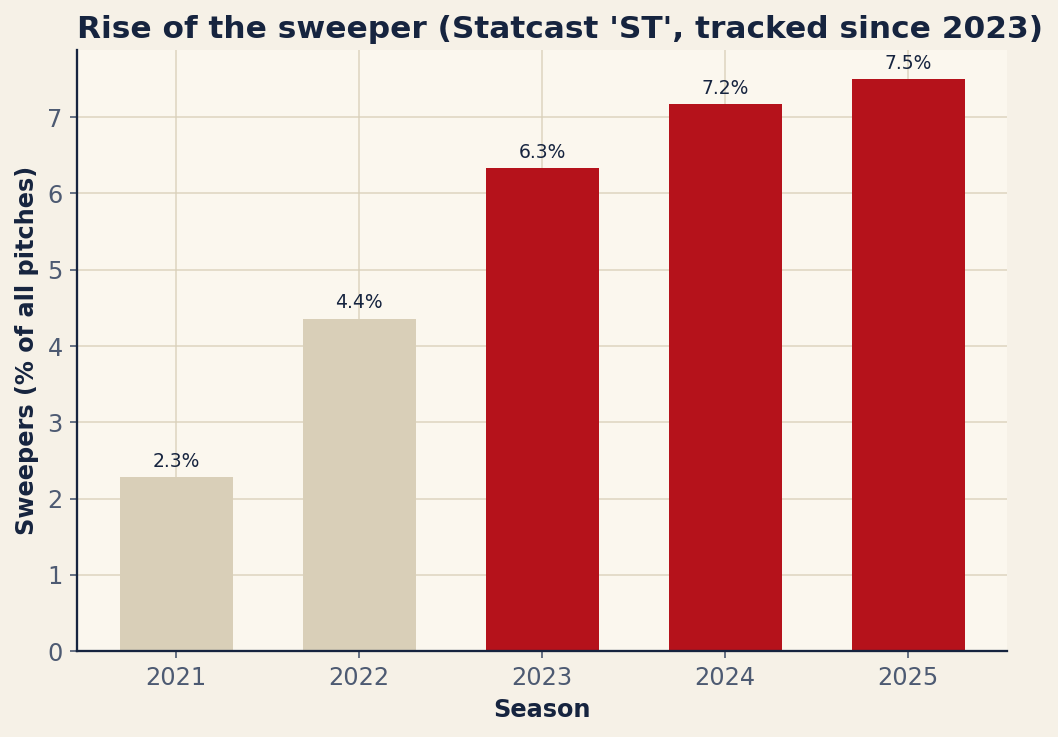
The rise is steep enough that it shows up cleanly in the league-wide pitch mix. In 2025 the sweeper accounted for 7.5% of every pitch thrown in the majors. Four years earlier that figure was a rounding error. This is what a genuine pitch-design revolution looks like in the data.
What a sweeper actually is
Start with the geometry, because the name is doing real work. A sweeper is a slider variant built to maximize horizontal movement — the “sweep” — while minimizing vertical drop. A traditional slider, often called a gyro slider, spins mostly on a bullet-like axis: it’s tight, hard, and breaks late and short, more of a depth pitch than a sideways one. The sweeper trades velocity for a much bigger east-west move, sometimes a foot or more of glide across the zone, with comparatively little downward break.
That difference matters because the two pitches attack hitters differently. The gyro slider is a late, subtle weapon that plays off a fastball at similar speed. The sweeper is a loud, obvious sideways pitch — a hitter can often see the break and still not be able to do anything about it, because the ball is leaving the bat path entirely. In a same-handed matchup it can start at a hitter’s hip and finish off the outside corner, or start over the plate and end up in the other batter’s box. The shape is the whole point.
The technology behind the boom
Sweepers are not a new idea — pitchers have thrown big sweeping breaking balls for generations, often by accident, sometimes calling them “frisbee” sliders. What changed was the ability to measure, copy, and teach the shape on purpose. Three tools did most of the heavy lifting.
The first is high-speed video. Edgertronic cameras, running at thousands of frames per second, let a pitching coordinator see exactly how the ball comes off the fingers — the grip, the seam orientation at release, the wrist action — and reproduce a desired release frame by frame. The second is ball-tracking radar and optics: Rapsodo and TrackMan units sit behind the plate or the mound and read back spin rate, spin axis, and the actual movement of every pitch in inches. A pitcher can throw, look at a tablet, adjust his grip, and throw again, closing the loop in seconds instead of seasons.
The third piece is conceptual rather than mechanical, and it’s the one that unlocked the sweeper specifically: a working understanding of seam-shifted wake. The movement on a sweeper isn’t purely a function of how fast the ball spins; the orientation of the seams as the ball travels disturbs the air on one side, nudging the ball in a direction the raw spin axis wouldn’t predict. Once design staffs understood that they could chase movement through seam orientation, not just spin rate, the giant sideways break stopped being a happy accident and became a recipe.
The numbers behind the spread
Here is the league-wide sweeper share, season by season. Before reading it, one classification note that explains the whole shape of the table.
| Season | Sweeper % | Sweeper pitches | Total pitches |
|---|---|---|---|
| 2021 | 2.28 | 15729 | 689683 |
| 2022 | 4.36 | 30057 | 688895 |
| 2023 | 6.33 | 44173 | 698014 |
| 2024 | 7.17 | 49461 | 690008 |
| 2025 | 7.50 | 51716 | 689293 |
Statcast did not formally recognize the sweeper as its own pitch type — tagged ST in the data — until 2023. Crucially, Baseball Savant applied that new classification retroactively, re-running its pitch-type model over earlier seasons. That’s why a pitch the sport barely talked about in 2021 still shows a 2.28% share that year: those are pitches that, by today’s definition, would have been sweepers, re-labeled after the fact. So the 2021 and 2022 bars aren’t evidence that sweepers were a known, deliberately thrown weapon then — they’re the model telling us how many already-existing breaking balls fit the sweeper mold before anyone was teaching it on purpose.
Read with that caveat, the curve is still dramatic. The retroactively classified share nearly doubles from 2.28% in 2021 to 4.36% in 2022, then jumps to 6.33% in 2023 — the first year of the official label and the first year of full, conscious adoption — before climbing to 7.17% in 2024 and 7.5% in 2025. The pace cooling slightly at the top is exactly what you’d expect once a tool moves from underused to roughly correctly used across the league.
Why it spread so fast
New pitches usually diffuse slowly, because they’re hard to learn or risky to the arm. The sweeper spread fast because it is neither. The grip is forgiving and the movement is generated more by seam orientation and a sweeping wrist than by violent effort, so a lot of pitchers can pick up a usable version in a bullpen or two. When a pitch is cheap to acquire, it diffuses at the speed of information — and the information was sitting right there on the Rapsodo screen.
The other half of the answer is that it works, brutally, in the matchup it’s built for. Against same-handed hitters — righty-on-righty, lefty-on-lefty — the big horizontal break runs away from the barrel and off the plate, generating ugly swings and weak contact. A pitch that turns a same-handed at-bat into a near-automatic advantage, and that you can teach in an afternoon, was always going to get thrown more. The wonder is that it took until 2023.
The tradeoffs nobody advertises
A sweeper is not a free lunch, and the same physics that make it lethal to same-handed hitters create its biggest weakness. Because the pitch breaks so heavily to one side, it has pronounced platoon splits. The horizontal movement that runs away from a same-handed hitter runs toward an opposite-handed one — a sweeper from a right-hander breaks back over the plate toward a lefty, often arriving belt-high and flat, which is to say arriving as a mistake. Hitters with the platoon advantage feast on sweepers that catch too much of the zone.
That asymmetry shapes how the pitch gets used. It’s a put-away and matchup weapon, leaned on hardest against same-handed bats and in counts where a chase swing is likely, and dialed back — or paired with a pitch that moves the other way, like a changeup or a cutter — against opposite-handed hitters. A pitcher who throws nothing but sweepers to the whole lineup is handing half the order a pitch built to their swing. The art, now that everyone has the shape, is in the sequencing and the willingness to throw something else.
The bottom line
The sweeper is the clearest recent case of measurement changing the game. The pitch existed for decades as a quirk; high-speed cameras, spin-and-movement radar, and the seam-shifted-wake insight turned it into something a coordinator could design, teach, and deploy at scale, and the league-wide share climbed from a retroactive 2.28% in 2021 to 7.5% in 2025. It is not a magic pitch — the platoon splits are real and the opposite-handed hitters will punish a lazy one — but it has permanently widened the menu. When you next see a breaking ball slide a foot sideways and a hitter wave at where it used to be, you’re watching the output of a lab, not just an arm.
Sources & Further Reading
- Usage data: Baseball Savant (pitch-arsenal leaderboard, sweeper classification
ST). Figures retrieved June 2026; computed for this article from that source. - MLB.com — reporting on the sweeper’s introduction as a tracked pitch type and its league-wide adoption.
- FanGraphs — pitch-design and seam-shifted-wake analysis.