When MLB restricted defensive shifts ahead of the 2023 season, the pitch was straightforward and the marketing was loud: balls that used to die in the glove of an infielder parked in shallow right field would finally fall for hits, the league’s sagging batting average would rebound, and the pull-side left-handed hitter would be liberated. Two full seasons later, the data has rendered its verdict, and it is considerably quieter than the promise.
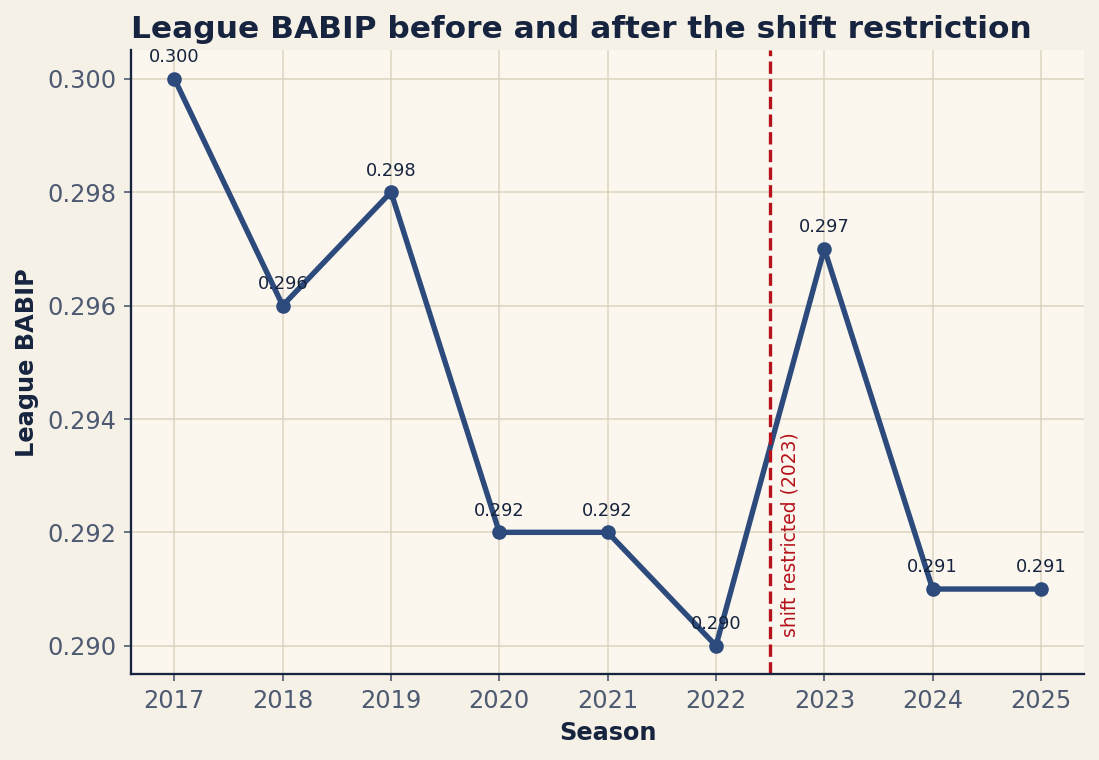
League BABIP — batting average on balls in play, the single number most directly tied to whether well-struck balls find grass — was .290 in 2022, the last shifted season. In 2025 it sits at .291. The gap between the promise and the result is the entire story.
What the 2023 rule actually requires
The restriction is more specific than “no shifts.” The rule mandates that all four infielders keep both feet on the infield dirt when the pitch is released, with two of them positioned on each side of second base. A team can no longer slide its second baseman into short right field, nor stack three infielders on the pull side of a dead-pull left-handed hitter. The defenders may still position aggressively within those constraints — deep, shaded, pinched — but the cheat code of a fourth man standing in the outfield grass is gone.
The intent was unambiguous. By forcing two infielders to the left of second base, the league meant to reopen the 3-4 hole and the right-field gap for left-handed pull hitters, the population most punished by the old alignments. More ground balls would sneak through, BABIP would climb, and the sport would get more balls in play and fewer three-true-outcome staring contests.
What was expected
The projections circulating before 2023 were not subtle. Some estimates had league batting average rising ten to twenty points; left-handed hitters who had spent years rolling over into the teeth of a four-man infield were supposed to see their BABIP jump appreciably. The logic was sound on paper: shifts had measurably suppressed ground-ball hits for years, so removing them should hand those hits back.
The expectation wasn’t merely “a few more hits” — it was a structural correction to a decade of defensive arms-race that had quietly drained offense out of the game.
That framing set up a clean test. If positioning was the dominant cause of the offensive decline, banning the shift should produce a large, durable spike in balls finding grass. If positioning was only one factor among many — strikeouts, velocity, hitter approach — the effect would be small and possibly temporary.
What the data shows
Here is the full BABIP picture, alongside batting average and strikeout rate, from 2017 through 2025.
| Season | BABIP | AVG | K% |
|---|---|---|---|
| 2017 | 0.300 | 0.255 | 21.6 |
| 2018 | 0.296 | 0.248 | 22.3 |
| 2019 | 0.298 | 0.252 | 23.0 |
| 2020 | 0.292 | 0.245 | 23.4 |
| 2021 | 0.292 | 0.244 | 23.2 |
| 2022 | 0.290 | 0.243 | 22.4 |
| 2023 | 0.297 | 0.248 | 22.7 |
| 2024 | 0.291 | 0.243 | 22.6 |
| 2025 | 0.291 | 0.245 | 22.2 |
The story lives in three rows. In 2022, the final shifted year, league BABIP was .290. In 2023, the rule’s debut season, it rose to .297 — a seven-point bump, real and in the predicted direction. And then it gave most of it back: .291 in 2024 and again in 2025. The one-year jump faded almost as quickly as it arrived.
The cleanest summary statistic is the one that should give the rule’s loudest backers pause. Average BABIP across the six pre-rule seasons in the table — 2017 through 2022 — is .295. Average BABIP across the three post-rule seasons is .293. The rule was sold as a way to raise that number, and the post-ban league is running two points below the pre-ban league. Both figures are the plain mean of the rows printed above, so you can check them on the table without leaving the page.
Why the bump faded
The most likely explanation is the dullest one: defenses adapted. The rule constrains where infielders may stand, but it does not stop teams from positioning intelligently within the lines. Clubs leaned harder on data-driven straight-up alignments — shading the right defender a few steps, pinching middle infielders toward the bag, and crucially repositioning the outfield to cover the gaps that pull hitters now found. A left fielder playing a dead-pull lefty can erase a lot of what a banished infielder used to catch.
There’s a hitter-side factor too. The ban rewarded going the other way and hitting the ball in the air, and as hitters and defenses both recalibrated over 2024 and 2025, the brief windfall of grounders sneaking through a momentarily confused defense closed. The 2023 spike looks less like a permanent regime change and more like the lag before the league’s defensive intelligence caught up with the new rulebook.
Strikeout rate underlines the point. K% barely budged across the window — 22.4% in 2022, 22.7% in 2023, and down to 22.2% by 2025, all of it below the league record of 23.4% set in 2020 and the 23.2% of 2021. The shift ban was never going to put more balls in play if hitters kept striking out at the same clip, and they did. You cannot collect a ground-ball single on a pitch you swing through.
Being honest about the gap
It would be easy to spin the 2023 number into a success story — “BABIP rose after the ban” is technically true. But intellectual honesty requires holding the whole table in view. A seven-point, single-season bump that reverts to baseline within two years is not the structural offensive revival that was advertised. That the post-rule average (.293) sits slightly below the pre-rule average (.295) is not a rounding artifact you can wave away; two points is small, but it points the wrong way, and that is the headline.
This is a useful case study in how rule changes get sold versus how they land. The shift ban was real, well-intentioned, and produced a visible first-year wiggle in exactly the predicted direction. It simply turned out that defensive positioning was one lever among several, and that a league full of analytically sophisticated teams will route around a constraint within a season or two. The promise oversold the mechanism; the data caught up.
The bottom line
The 2023 shift restriction did what its narrowest defenders claimed — BABIP rose, briefly, from .290 to .297 — and almost nothing of what its loudest ones promised. By 2025 the number had settled to .291, leaving a post-rule average of .293 against a pre-rule average of .295. The hits the ban was supposed to unlock mostly got re-caught by smarter alignments and outfields. Two seasons later, the league-wide effect is a rounding error, and the distance between the advertisement and the result is the whole point.
Sources & Further Reading
- League hitting totals: MLB.com (MLB Stats API season hitting totals). Numbers retrieved September 2026; computed for this article from that source.
- Baseball Savant — batted-ball and infield-alignment data for shift-era research.
- FanGraphs — league BABIP, batting average, and strikeout-rate leaderboards by season.