Somewhere around 2015 the stolen base became a sucker’s bet, and the spreadsheets are the ones who said so. At the success rates teams were actually posting, the runs you gained from swiping a bag rarely outweighed the runs you torched getting thrown out. A caught-stealing killed rallies, the math was unforgiving, and managers listened all decade long. By 2019 the league was down to roughly 0.47 steals per team-game — the lowest in a generation, and falling.
Then, in 2023, Major League Baseball changed three rules at once, and the stolen base did not just recover — it came roaring back to levels the sport hadn’t seen in decades. The number of steals jumped, and the success rate jumped with it, which is the combination that tells you something real happened. This is the rare case of a rule change that worked exactly as advertised.
The number that snapped
Start with the headline. In 2022, the last season under the old rules, teams stole roughly 0.51 bases per game. In 2023, that leapt to 0.72 — a jump of more than 40 percent in a single offseason, with no change to the players, only to the rulebook. And it held: 2024 came in even higher at about 0.74, and 2025 settled back only slightly to 0.71. This was not a one-year novelty that defenses solved by spring. It was a permanent reset of how the game is played.
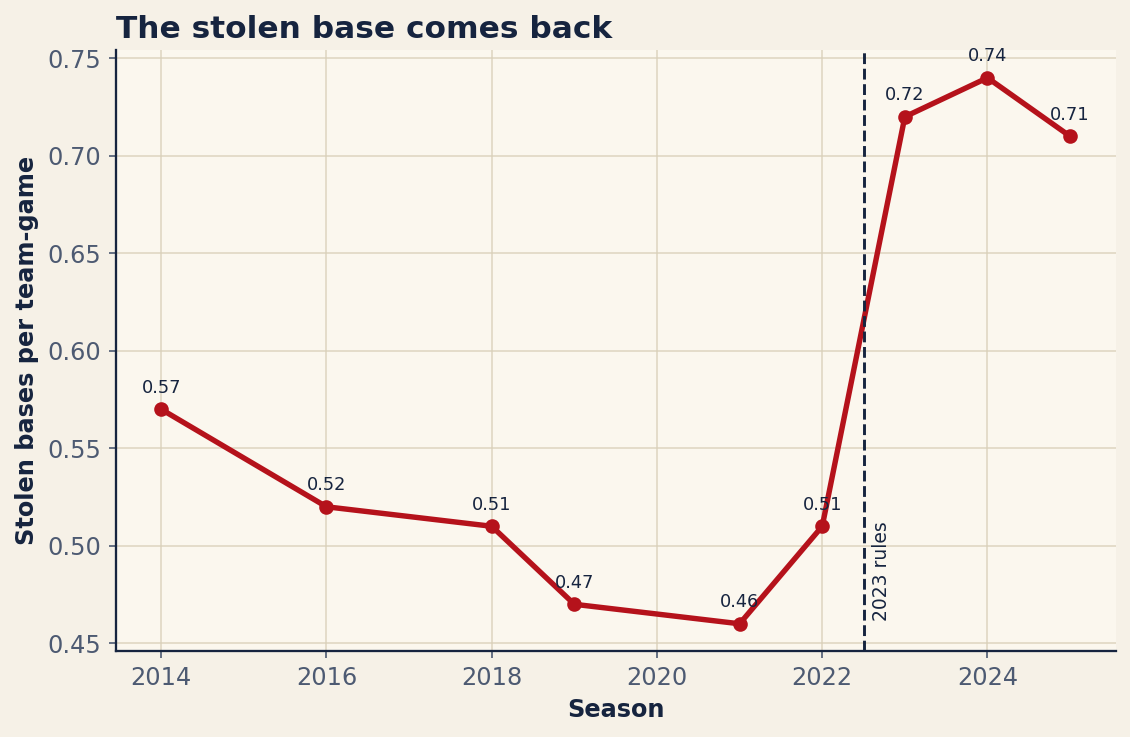
The chart makes the discontinuity almost comic. Look at the long, gentle decline through the 2010s — 0.57, 0.52, 0.51, 0.47 — a slow bleed toward irrelevance. Then the dashed 2023 line, and the curve doesn’t bend so much as snap upward. Baseball numbers rarely move like that. Aging trends, talent cycles, and the slow churn of strategy usually nudge the league a few points a year. A vertical jump like this one is the fingerprint of a rule change, not a fashion.
Why both the volume and the success rate rose
Here is the detail that separates a real effect from a mirage. If only the number of steal attempts had risen, you might suspect teams were simply running more recklessly — trading more outs for more bags, a wash or worse. But the success rate climbed too, from about 75.4 percent in 2022 to 80.2 percent in 2023. Runners were attempting far more often and getting caught far less. That only happens when the underlying act of stealing has genuinely gotten easier, which is precisely what the new rules engineered.
The 80-percent line matters because it is roughly the break-even point above which steals reliably add runs. For years the league hovered in the mid-70s, just low enough to make aggressive running a bad bet. The 2023 rules shoved the whole enterprise over that threshold, and rational managers responded by turning their fast players loose.
| Season | SB / game | Attempts / game | Success % |
|---|---|---|---|
| 2014 | 0.57 | 0.78 | 72.8 |
| 2016 | 0.52 | 0.73 | 71.7 |
| 2018 | 0.51 | 0.71 | 72.1 |
| 2019 | 0.47 | 0.64 | 73.3 |
| 2021 | 0.46 | 0.60 | 75.7 |
| 2022 | 0.51 | 0.68 | 75.4 |
| 2023 | 0.72 | 0.90 | 80.2 |
| 2024 | 0.74 | 0.94 | 79.0 |
| 2025 | 0.71 | 0.91 | 77.7 |
Rule one: bigger bases
The least glamorous change had a real geometric effect. MLB enlarged the bases from 15 inches square to 18 inches. That sounds cosmetic, but it shortens the distance a runner has to cover. The gap between first and second shrinks by four and a half inches, and the same at second-to-third. On a play decided by a fingertip and a fraction of a second, four and a half inches of free distance is not nothing — it is a small, permanent thumb on the scale in the runner’s favor, applied to every attempt all season.
Rule two: the disengagement limit
This is the big one. Under the new rules a pitcher gets only two “disengagements” — pickoff throws or step-offs — per plate appearance. Attempt a third and fail to record the out, and it’s a balk: the runner advances for free. The pickoff move had always been the throttle on the running game; a pitcher could hold a fast runner close with the constant threat of a throw to first. The disengagement cap takes that throttle away after two uses.
A smart baserunner now counts. Once a pitcher has spent both pickoff throws, the runner knows the pitcher is effectively pinned — any further attempt risks handing over the base — and can take an enormous, aggressive lead with near-impunity. That single rule rewrote the leverage between pitcher and runner more than any base size ever could.
Rule three: the pitch timer changes the math
The pitch timer was introduced to speed up the game, but it had a side effect that bled straight into the running game. With a clock ticking, pitchers lost the freedom to hold the ball indefinitely, vary their timing at will, and keep runners guessing about when the next pitch — or pickoff — was coming. Predictable timing is a baserunner’s best friend. The clock imposed a rhythm the runner could read and exploit, and it discouraged the endless stepping-off that used to reset a jumpy runner’s timing. Combined with the two-disengagement cap, the timer left pitchers with fewer tools and less time to deploy the ones they had left.
The contrast: when a rule change does not work
It is worth holding this success up against the other marquee change of 2023, because the comparison is instructive. The same rulebook that turbocharged the running game also banned the infield shift, requiring two infielders on each side of second base. The stated goal was to restore base hits and bring offense roaring back. The actual effect on the bottom line was muted — far smaller than the shift’s advocates had promised, as we covered in the shift ban two seasons later. Hitters adjusted, the run-scoring needle barely twitched, and the change quietly underdelivered.
The stolen-base rules are the photographic negative of that story. They were not over-hyped; if anything they were under-appreciated next to the louder shift debate. They targeted a specific behavior with three reinforcing mechanisms — geometry, leverage, and tempo — and the behavior moved, hard, in the intended direction, and stayed moved for three straight seasons. When people argue that rule tweaks can’t meaningfully change how baseball is played, the stolen base is the counterexample that ends the argument.
The bottom line
The stolen base came back because three rules made it the correct play again. Bigger bases shortened the trip, the disengagement limit stripped the pitcher of his pickoff throttle, and the pitch timer handed runners a readable rhythm — and the proof that it worked is that attempts and success rate climbed together, from 0.51 steals a game at a 75-percent clip to 0.72 at better than 80, holding near 0.71 two years on. Managers did not get braver and players did not get faster. The rulebook simply made an old, beautiful play pay again, and the game looks more alive for it.
Sources & Further Reading
- Stolen-base data: MLB.com (MLB Stats API, league baserunning by season). Numbers retrieved June 2026; computed for this article from that source.
- Baseball Savant — sprint speed, jump, and pickoff data for the mechanics behind the running game.
- Baseball-Reference — long-run stolen-base and caught-stealing histories for the pre-2023 baseline.