Open a Statcast leaderboard for the first time and it looks like a wall of red and blue: little colored bubbles next to every number, a column for exit velocity, another for barrels, another for chase rate, a few you’ve never heard of. It is, genuinely, the best free window into baseball that has ever existed. It is also a machine for fooling yourself, and most of the bad takes lifted off of it come from three or four mistakes people make over and over. So this is the guide to have from the start: how to read one of these boards without walking away believing something that isn’t true.
We’re going to talk in terms of the Baseball Savant percentile rankings — the player pages with the colored sliders — because that’s the version most people actually look at. But the same instincts carry over to any leaderboard with a sortable column and a date range.
The colors are percentiles, not grades
The single most important thing to internalize: those red and blue bubbles are percentiles, not raw values and not letter grades. A bright red 95th-percentile exit velocity means the player is harder-hitting than 95 percent of his peers in that population — it does not tell you the actual number, and it does not mean “95 out of 100” in any absolute sense. The percentile is relative to a pool, and the pool matters. Hitters are ranked against qualified hitters; pitchers against pitchers. Change the population and the same raw number lands on a different color.
This sounds pedantic until you watch someone compare a starter’s percentile to a reliever’s, or a part-timer’s to a full-season regular’s, and conclude something the data never said. Two players can post the identical 91.5 mph average exit velocity and sit at different percentiles in different years simply because the league around them moved. Percentiles are a fantastic way to say “how does this guy stack up right now,” and a terrible way to compare across seasons or across populations. When we want to track a player over time, we pull the raw value, not the color.
Raw value or percentile? Pick the right one for the question
Here’s the rule we use. If the question is where does this player rank among his peers this season, the percentile is exactly the tool — it’s built for that. If the question is did this player actually change, or how do two different seasons compare, you want the raw value, because the percentile silently re-baselines every year. A hitter whose average exit velocity held perfectly steady at 90 mph can drift from the 70th percentile to the 60th without swinging any differently, just because the league got harder around him. The slider moved; the player didn’t.
Neither is “better.” They answer different questions. The mistake is using the percentile — which is the prettier, more prominent number on the page — for the comparison the raw value is supposed to handle.
Signal versus noise: the sample-size problem
Now the big one. Every number on a leaderboard is computed over some sample, and a small sample is a liar. The board will happily show you a hitter sitting at a .650 wOBA over his first nine plate appearances of the year, bubble glowing the brightest red the page can render, and that number means essentially nothing. It is four good swings and a lot of luck. The leaderboard does not warn you. It just shows the number.
So before we react to anything, we look at the denominator. How many batted balls is this exit-velocity ranking built on — twelve, or two hundred? How many pitches feed this chase rate? A metric computed over thirty events and the same metric over a full season are not the same kind of object, even when the column header is identical. The leaderboard flattens that distinction into one tidy cell, and reading it well means mentally un-flattening it every single time.
Which metrics stabilize fast (and which don’t)
The good news is that not all metrics are equally noisy, and the differences are knowable. A statistic “stabilizes” when it has accumulated enough events that the number is mostly skill rather than mostly luck — when, roughly, half of what you’re seeing is the real player. The order is consistent, and it tracks how directly the stat measures the swing or the pitch itself versus a downstream outcome:
Middle (a few hundred events): strikeout rate, walk rate, average exit velocity, barrel rate, hard-hit rate.
Stabilizes slowly (most of a season or more): BABIP, batting average, ERA, and anything heavily filtered through defense and sequencing luck.
Treat those as the order of trust, not as exact thresholds — the precise sample where each one “stabilizes” varies by study and by how you define it, and we’re not going to quote you a specific event count as gospel. The pattern is what matters. The further down that list a stat sits, the longer you wait before believing the leaderboard. Why the order? Because the top of the list measures things the player controls directly and does constantly — a hitter makes a swing decision on nearly every pitch, so chase rate piles up evidence fast. The bottom measures outcomes that pass through fielders, ballparks, and the timing of when hits clump together, none of which the hitter controls and all of which add noise. This is the same logic that powers regression to the mean: the noisier the stat, the harder it regresses toward the player’s true level.
The practical payoff is enormous. In April, if a hitter’s chase rate has genuinely dropped, we’ll believe it well before we believe his shiny new batting average, because chase rate has already seen hundreds of decisions while the average is still mostly noise. The leaderboard shows both in the same red. Only one of them has earned it yet.
Common misreadings, collected
Most leaderboard disasters are one of these:
- Treating a percentile as a raw value. A 70th-percentile barrel rate is not “70 percent of balls were barreled.” It’s a rank. The actual barrel rate is a small single-digit number for almost everyone.
- Reacting to small samples. The most extreme bubbles in April are almost always the smallest samples. Big numbers and tiny denominators travel together; the loudest cell is frequently the least real.
- Comparing across mismatched populations. A starter and a reliever, or a regular and a bench bat, ranked against different pools, then compared as if the colors mean the same thing.
- Trusting outcome stats over skill stats too early. Believing a hot batting average while ignoring that the chase rate and whiff rate — the stats that stabilize first — haven’t budged. The outcome will usually drift back toward the skills.
- Forgetting expected stats exist. When wOBA and xwOBA diverge hard, the leaderboard is quietly telling you luck is involved. Read both columns, not just the one that flatters your take.
A reading checklist
When a leaderboard cell jumps out, run the same four questions before saying anything out loud. What’s the sample — how many events is this built on? Is this a percentile or a raw value, and which one does the question actually need? Where does this metric sit on the stabilization list — is it the kind of stat you can trust early, or the kind that needs a full season? And does an expected-stat sibling agree, or is something lucky propping this up? Four questions, fifteen seconds, and most embarrassing takes never get said out loud.
The bottom line
A Statcast leaderboard is not a verdict; it’s a pile of evidence of wildly varying quality, presented in uniform, confident colors. The skill is learning to discount the right cells — to see a glowing 99th-percentile bubble over nine plate appearances and feel nothing, while a quiet, unsexy chase-rate improvement over four hundred pitches makes you sit up. Read the denominator, know which stats have earned your trust, and keep the percentile and the raw value in their separate lanes. Do that and the same board that generates bad takes for everyone else starts handing you real ones.
Sources & Further Reading
- Baseball Savant — the percentile rankings and sortable Statcast leaderboards discussed throughout.
- FanGraphs Library — reference on stat reliability and the samples at which common metrics stabilize.
- Russell Carleton, writing on stabilization points — the sabermetric research establishing how quickly different stats become reliable.
- Tom Tango, Mitchel Lichtman & Andrew Dolphin, The Book: Playing the Percentages in Baseball — on luck, skill, and reading samples honestly.
Anatomy of a breakout
This section was first published on June 4, 2026 as a separate article. Data: Baseball Savant.
Every spring a few hitters come out hot and the internet declares them changed men. Most of them aren’t. A six-week heater is the easiest thing in baseball to fake — a few seeing-eye singles, a friendly schedule, a couple of wind-aided home runs — and the surface numbers can stay inflated for months before the bottom falls out. The hard question isn’t “is this player hot?” It’s “is this player better?” Those are not the same question, and Statcast is the only place that reliably tells them apart.
What follows is a four-test framework for separating a real breakout from a lucky streak, with one worked example running through all of it. In 2025 George Springer, deep into his thirties and seemingly in decline, posted one of the largest expected-offense jumps in baseball. We’ll use him to show what a genuine breakout looks like under the hood.
Test 1: Do the expected stats move, not just the results?
The first filter throws out most pretenders. Batting average, slugging, and even wOBA are outcome stats — they record what happened, luck and defense and ballpark included. The expected stats, xwOBA and xSLG, record what should have happened given how hard and at what angle every ball was hit. If a hitter’s results have spiked but his expected stats haven’t, you’re looking at variance wearing a costume. If both move together, something structural has changed. This is the same done-versus-deserved gap covered in our guide to expected stats, used here as a lie detector.
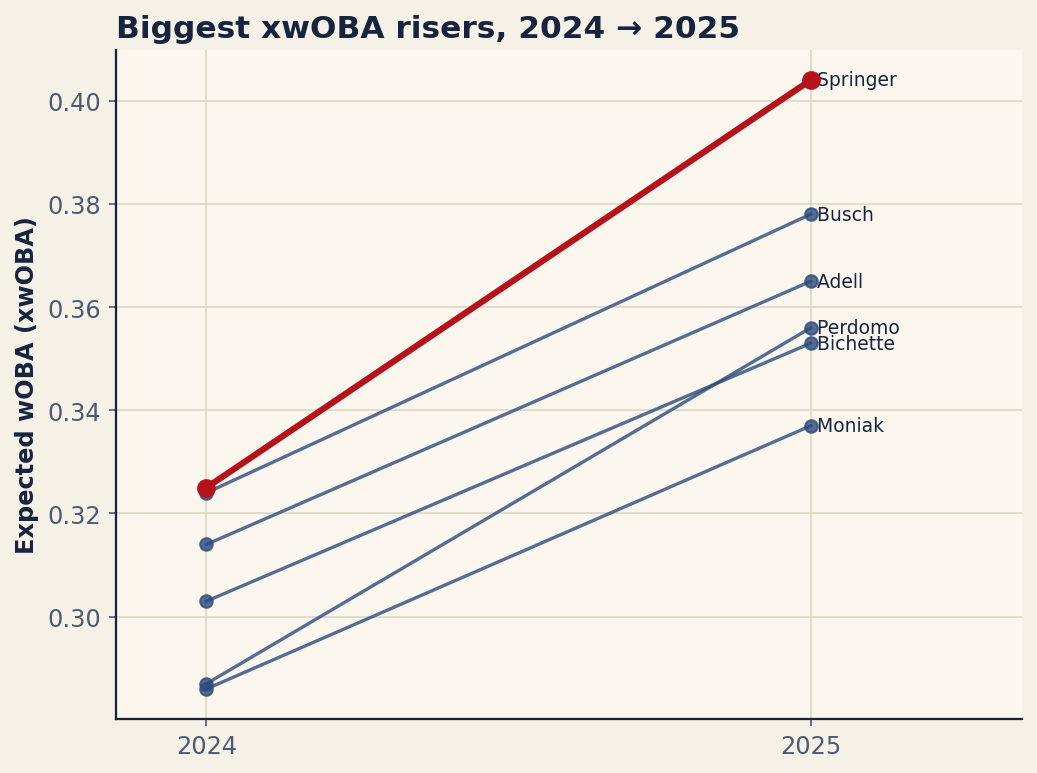
Springer clears this bar emphatically. His xwOBA climbed from .325 in 2024 to .404 in 2025 — a 79-point jump — while his xSLG leapt from .412 to .571. Those aren’t the fingerprints of a lucky month; they’re the contact profile of a different, and far more dangerous, hitter. The figure below plots the biggest expected-wOBA risers across the two seasons, and Springer’s line is one of the steepest on the board.
One more guardrail belongs in this test: sample size. An expected-stat jump over 120 plate appearances is interesting; over a full season it’s evidence. Springer’s came across 614 plate appearances in 2024 and 586 in 2025 — two full, healthy seasons. There’s no small-sample escape hatch here, which is exactly what you want before you believe a 35-year-old reinvented himself.
| Player | PA '24 | PA '25 | xwOBA '24 | xwOBA '25 | Δ | xSLG '24 | xSLG '25 |
|---|---|---|---|---|---|---|---|
| George Springer | 614 | 586 | 0.325 | 0.404 | 0.079 | 0.412 | 0.571 |
| Geraldo Perdomo | 388 | 720 | 0.287 | 0.356 | 0.069 | 0.326 | 0.424 |
| Michael Busch | 567 | 592 | 0.324 | 0.378 | 0.054 | 0.432 | 0.548 |
| Mickey Moniak | 418 | 461 | 0.286 | 0.337 | 0.051 | 0.387 | 0.497 |
| Jo Adell | 451 | 573 | 0.314 | 0.365 | 0.051 | 0.426 | 0.549 |
| Bo Bichette | 336 | 628 | 0.303 | 0.353 | 0.050 | 0.377 | 0.473 |
| Gleyber Torres | 665 | 628 | 0.314 | 0.363 | 0.049 | 0.386 | 0.462 |
| Ramón Laureano | 309 | 488 | 0.313 | 0.362 | 0.049 | 0.438 | 0.518 |
The table is also a reminder that not every riser is the same animal. Geraldo Perdomo jumped from a .287 to a .356 xwOBA, but he did it while more than tripling his playing time, from 388 plate appearances to 720 — a young player consolidating a role, which is a different story than an established veteran changing shape. Michael Busch (.324 to .378 xwOBA, .432 to .548 xSLG) and Jo Adell (.314 to .365, with xSLG up from .426 to .549) read more like Springer: real gains in contact quality over comparable workloads. The framework’s job is to tell those cases apart, and it starts by demanding the expected stats move.
Test 2: Did batted-ball quality improve?
Expected stats are downstream of contact, so the second test asks why xwOBA and xSLG moved. The inputs are the raw quality-of-contact numbers: average exit velocity, hard-hit rate (the share of batted balls struck at 95+ mph), and above all barrel rate — the percentage of batted balls in the launch-speed-and-angle sweet spot that produces extra-base damage. Barrels are the single most predictive contact stat there is, which is why they get their own treatment in our barrel-rate explainer.
The logic of the test is simple: a 159-point jump in xSLG, like Springer’s, has to be paid for in harder, better-angled contact. You cannot fake an xSLG that high; the model only awards it to balls that were genuinely smoked at productive angles. So when the expected-power number moves the way Springer’s did, it is itself the receipt — it is telling you the barrels and the hard-hit balls showed up, because nothing else generates that figure. A breakout that passes Test 1 on power almost by definition passes Test 2; the value of stating the test separately is to remind you to check that the engine, not the scoreboard, did the work.
Test 3: Did plate discipline change?
Contact quality is half of hitting; the other half is contact frequency and pitch selection. The third test looks at the plate-discipline column: chase rate (swings at pitches outside the zone), whiff rate (swings and misses), and the resulting walk and strikeout numbers. These matter for two reasons. First, they’re a hitter’s most repeatable skills — discipline metrics stabilize faster and fluctuate less than outcome stats, so a real change here is strong evidence of a real change overall. Second, they protect a breakout’s floor: a hitter who is squaring the ball up and chasing less has two engines driving the gains, not one.
This is also where the framework hits an honest limit. The dataset behind this article is the Statcast expected-stats leaderboard, which gives us xwOBA and xSLG cleanly but does not carry the full discipline breakdown for every hitter. Rather than invent chase and whiff figures, we’ll be straight about it: confirming Test 3 for Springer means going to his Baseball Savant page and reading the percentile sliders directly. The point of the test stands regardless — a breakout that also shows a lower chase rate or a better walk-to-strikeout ratio is far more trustworthy than one resting on contact quality alone — and you should always run it before betting on a hitter staying broken out.
Test 4: Is there a story that makes it sustainable?
The final test is the least quantitative and the most important. Numbers tell you that something changed; a mechanism tells you why, and a why is what makes a breakout sustainable rather than seasonal. Did the hitter rebuild his swing, change his stance or his hand position, move on the plate, adopt a new approach against a pitch that used to beat him? A documented mechanism turns a statistical blip into a plausible new baseline, because it gives you a reason to expect the gains to carry forward instead of regressing.
This is the test you can’t run from a spreadsheet, and it’s where reading, beat reporting, and swing video earn their keep. For a case like Springer’s — a veteran posting a 79-point xwOBA jump and a 159-point xSLG jump across two full seasons — the numbers all but demand a mechanism, and the analyst’s job is to go find it: the adjustment, the health change, the swing tweak that the data is implicitly pointing at. When the story and the Statcast page agree, you have a breakout you can believe in. When the numbers jump but no one can explain how, stay skeptical, because the most likely explanation is the one the expected stats already ruled out in Test 1: luck.
The bottom line
A real breakout leaves the same four-part signature every time: the expected stats move, not just the results; the contact quality that feeds them is genuinely better; the plate discipline holds or improves; and there’s a mechanism that explains the whole thing. George Springer’s 2025 — xwOBA from .325 to .404, xSLG from .412 to .571, over two full healthy seasons — clears the tests we can measure from this data and points hard at the ones we can’t. Run any hot start through these four filters before you buy in. Most streaks fail at the first test. The ones that pass all four are the players actually worth chasing.
Sources & Further Reading
- Expected-stat data: Baseball Savant (Statcast expected-statistics leaderboard, 2024 and 2025, min. 300 PA). Figures retrieved June 2026; computed for this article from that source.
- MLB.com — Statcast glossary definitions for xwOBA, xSLG, barrel rate, and the plate-discipline metrics.
- FanGraphs — plate-discipline leaderboards and breakout analysis.