Major League Baseball's average nine-inning game in 2026 runs two hours and forty-two minutes. Banana Ball's founding rule says no new inning after two hours. Everyone agrees the pitch clock worked — this site's own rules comparison calls it the largest single-season pace improvement in the sport's history, and it is. But "worked" deserves a measurement, so we built one: seventeen seasons of nine-inning game times, 36,000 games computed from primary logs rather than quoted from press releases. The measurement says three things the celebration usually skips. The clock returned baseball to roughly 2011, not to anywhere new. The number has already drifted six minutes off its 2024 floor, and drift-after-the-push is the oldest pattern in this dataset. And the forty-two minutes still separating MLB from Banana Ball's ceiling are not slack waiting to be disciplined away — most of them are literally on the schedule.
The measurement, and why you can trust it
The dataset behind this piece is data_layer/build_game_times.py. For 2010 through 2025 it parses Retrosheet's game logs — every major-league game, with the official duration and the game's length in outs — and keeps standard-length games (51–54 outs), which excludes extra innings, rain-shortened games, and 2020's seven-inning doubleheaders. For 2026 it pulls every completed regular-season game from the MLB Stats API and applies the same nine-inning filter. That yields between 2,089 and 2,245 qualifying games for every full season except pandemic 2020 (720), and 1,879 games for 2026 through August 31.
The definition matters, so the build reconciles itself against MLB's published nine-inning averages before it will write a dataset: our computed means for 2022 through 2025 land at 183.8, 159.9, 156.3, and 158.4 minutes against published figures of 184, 160, 156, and 158 — a maximum gap of 0.4 minutes, which says Retrosheet's clock and the league's are the same clock. The taupe diamonds in the chart are those published figures, drawn on top of the computed line. They are the audit, not the source.
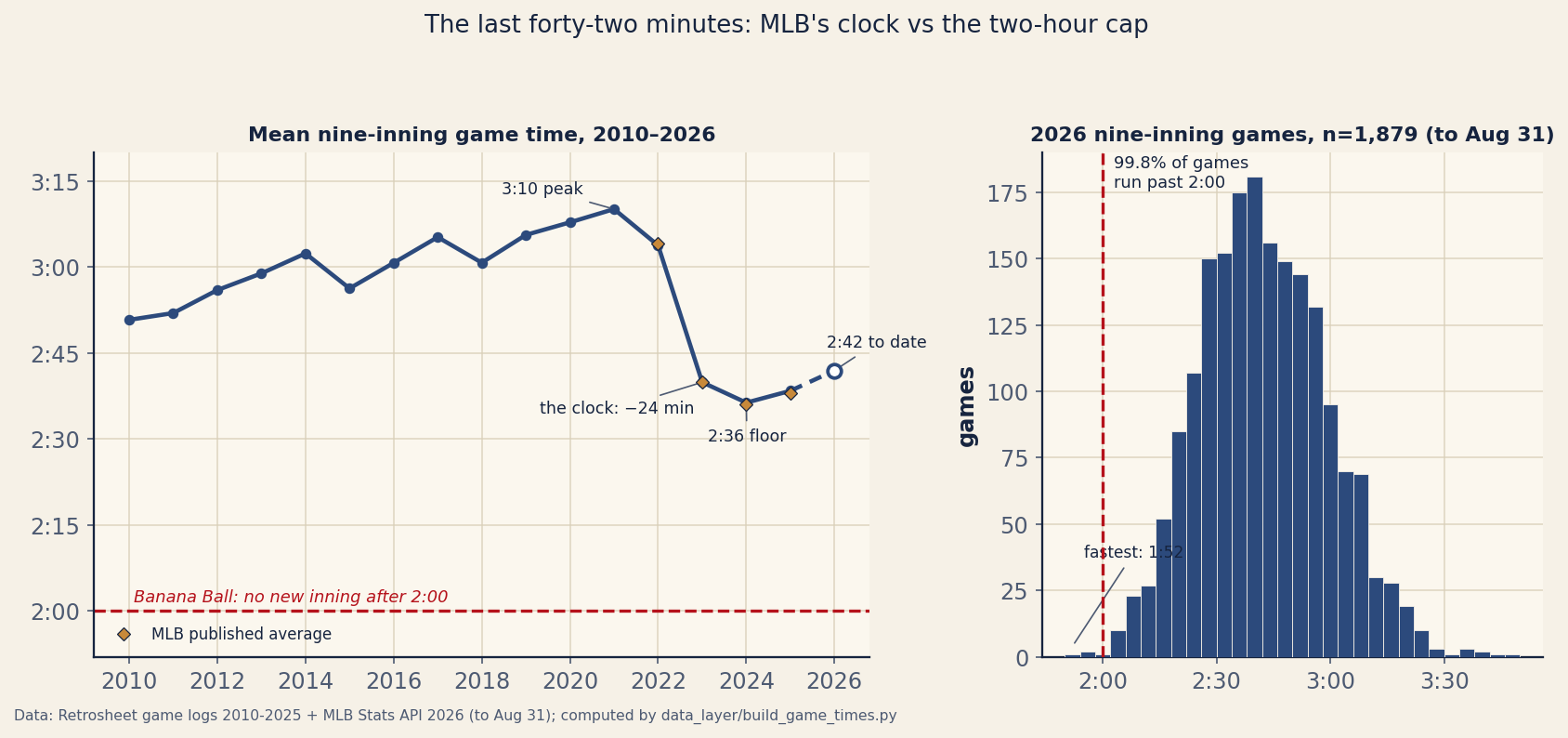
data_layer/build_game_times.py; drawn and asserted by charts/chart_game_times_cap.py.What the clock actually bought
The left panel's shape is the whole modern pace argument in one line. In 2010 the average nine-inning game ran 2:51. It crept upward almost every season for a decade — through the 2:56 of 2015, when a pace-of-play initiative (batter's-box rules, break timers) bought 6.1 minutes and the sport spent them back with interest, adding 13.8 minutes between 2015 and the all-time peak of 3:10 in 2021. Then the 2023 pitch clock cut 23.9 minutes in a single winter, from 3:04 to 2:40. Nothing else in the seventeen seasons is even the same species of event.
The tails moved harder than the mean. In 2021, we count 390 nine-inning games that ran three and a half hours or longer — essentially one per week per team. In 2023 there were nine. In 2024, seven. In 2025, three. (The wire-service figure of 391 for 2021 differs from our count by one game; close enough to call it the same number arrived at independently.)
Scale the cliff and you see why the league took the reputational risk: 23.9 minutes saved across 2,430 games is about 968 hours of baseball-adjacent standing around deleted per season — forty days of continuous dead time, every year. That is what Banana Ball had been attacking with a blunt stopwatch since 2020, and what MLB finally attacked with fifteen- and eighteen-second timers.
The drift is already back
Here is the part the victory laps leave out. The floor was 2:36, in 2024 — the fastest average since 1984, per MLB's own framing at the time. In 2025 it was 2:38. Through August 31 of 2026, across 1,879 nine-inning games, it is 2:42 — 5.6 minutes above the floor, in two seasons. The 3:30-plus tail tells the same story in miniature: three such games all of last season, eight already this season.
Two seasons of creep is not destiny, and the honest hedge cuts both ways. The clock is structural in a way 2015's polite memo never was; violations carry automatic balls and strikes, and nobody sane expects a return to 3:10. September could shave the to-date number a little, or not — this is a dated snapshot, and the build script will say so if the pin drifts. But this dataset contains exactly one precedent for what happens after every pace push it has ever seen, and the precedent is: the sport leaks time until someone tightens something. The league already tightened once, trimming the clock with runners on from twenty seconds to eighteen in 2024. The 2026 number says the next tightening conversation is coming.
The forty-two minutes nobody is chasing
Which brings us to the gap. 2:42 minus 2:00 is 41.9 minutes — the distance between the measured sport and the exhibition league's ceiling. It is tempting to read that as slack, proof that MLB is still fat. The schedule data says otherwise. The Stats API publishes each game's scheduled between-inning break length; the 2026 average is 122.3 seconds, and a full nine-inning game has up to seventeen of those turnarounds. That is about 35 minutes of scheduled break time per game — roughly 83 percent of the entire gap, committed before anyone throws a pitch. The pitch clock deleted the dead time inside innings; what remains between them is not dead, it is sold.
This is the real difference between the two products, and it is why the cap will never port. Banana Ball's two hours include its between-inning entertainment — the choreography is the product, so the show fills the breaks instead of selling them. MLB's breaks carry the broadcast model that pays for the sport. One format monetizes the gap, the other performs in it. Neither is being lazy; they have priced the same minutes differently. (Precision matters here, so note the rule's actual wording: no new inning starts after two hours — the inning in progress finishes, so a Banana Ball game can run a few minutes past its ceiling. It is a ceiling on innings, not a guillotine on the clock.)
What a hard cap would actually do to MLB
The right panel is the reductio. Of 1,879 nine-inning games this season, 1,875 — 99.8 percent — ran past two hours. The fastest game of the year finished in 1:52; the slowest took 3:49. Drop Banana Ball's ceiling onto the measured sport and effectively every game in the league gets its late innings amputated, which is why the league that uses the rule also rescores the game around points per inning — truncation is fair when every inning is its own contest, and catastrophic when a season-long run ledger is the product. A two-hour cap is not a pace tool MLB declined to adopt. It is a different sport's load-bearing wall.
Per this site's standing rule for the category, no Banana Ball performance statistics appear in this piece — the league's scorekeeping is part of its show, and the honest comparison is rulebook-to-rulebook and clock-to-clock, which is what the numbers above are.
Limitations
The 2026 figure covers the season through August 31 and will move a little by October. The nine-inning cut is a definitional choice — it excludes extra innings in both eras, which is the conservative choice given that the placed-runner rule shortened extras from 2020 onward. Retrosheet's duration field is the official game time, which excludes delays; the 0.4-minute reconciliation with MLB's published averages is the evidence both clocks share that definition. The break-length figure is the scheduled value the API publishes, not a stopwatch on actual turnarounds, and seventeen breaks assumes the home team bats in the ninth. And 2020's 720-game season is included where it appears, small sample disclosed.
Sources
- Game durations and outs, 2010–2025: Retrosheet game logs (
gl2010.zip–gl2025.zip), parsed bydata_layer/build_game_times.py. The information used here was obtained free of charge from and is copyrighted by Retrosheet. Interested parties may contact Retrosheet at www.retrosheet.org. - 2026 durations, nine-inning filter, and scheduled inning-break lengths: MLB Stats API schedule endpoint (statsapi.mlb.com), regular-season games through 2026-08-31, pulled 2026-08-31.
- MLB's published nine-inning averages used for reconciliation (2022 3:04, 2023 2:40, 2024 2:36 — the "fastest since 1984" season — and 2025 2:38, plus the 391-game 2021 long-game count): MLB figures as reported by the Associated Press and carried widely, including Yahoo Sports and Fox Sports, September 2025.
- Banana Ball's time-limit rule (no new inning after two hours, current 2026 ruleset): the league's published rules as documented in the companion explainer (verified July 2026) and re-checked August 2026 against independent 2026 rules guides.
- Chart and every published number asserted by
charts/chart_game_times_cap.py(45 pinned values recomputed from the bundled JSON at run time).