There are two kinds of September races, and the schedule decided which is which months ago. In the first kind, the teams involved still play each other, and every one of those nights is guaranteed to move the race — somebody wins, somebody loses, the gap changes by exactly one game before the clubhouse spread is cold. In the second kind, the rivals never meet again. Nothing either team does can touch the other directly; the race is settled by proxies, third parties, and scoreboard-watching. As of the morning of September 3, with 2,100 games played and 331 left, baseball is running both kinds at once — and the assignment of races to categories is stranger than it has any right to be.
The National League East, the widest gap among the six live races at four full games, is the most self-settling race in baseball: the Braves and Phillies play each other seven more times. And the American League West, the closest division race in the sport at two games, is fully hostage: the Astros and Rangers are done with each other. Texas could win out — all 22 — and if Houston matched them win for win against other people, the Rangers would finish exactly two games back, having never gotten a swing at the team in front of them.
Why a head-to-head game counts double — exactly, not folklorically
Broadcasters call September head-to-heads “four-point games,” borrowing loosely from soccer. The arithmetic underneath is simpler and worth stating exactly. When two race rivals play each other, the gap between them moves by one game, with certainty — there is no outcome in which it stays put. When they play separate opponents on the same night, the gap moves only if their results diverge, and for two roughly .500 teams that happens half the time: the probability one wins while the other loses is 0.5 × 0.5, twice over, which is 50%. A head-to-head night moves a race twice as fast as an ordinary night, and unlike the ordinary night it can never leave the race where it stood. That is the entire mechanism. It isn’t about rivalry adrenaline or October previews; it’s variance concentration, scheduled in advance.
The flip side matters just as much: a head-to-head game can’t move both ledgers up. In a six-team scrum, every intra-scrum game forces a loss onto somebody in the race. Games against outsiders are the only ones where the whole scrum can gain ground on the seat at once — or all fail together.
The six races, sorted by who can still touch whom
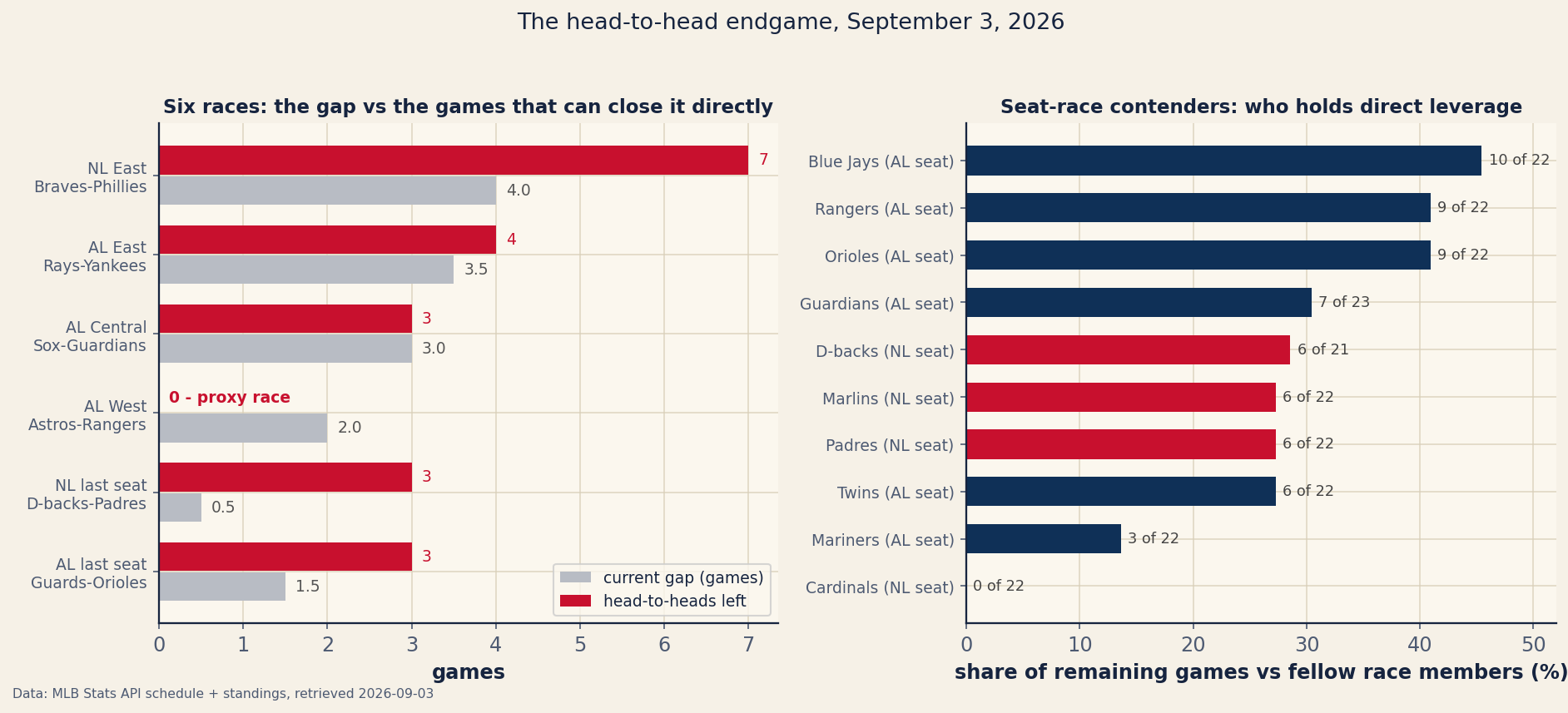
Run down the left panel and the mismatch between closeness and controllability is the story. The NL East’s four-game gap comes with seven direct meetings — a Phillies sweep would flip a 4.0-game deficit into a 3.0-game lead with no help from anyone. The AL East’s 3.5-game gap comes with four meetings; a Yankees sweep flips it by itself. The AL Central’s 3.0 comes with exactly three Guardians–White Sox games — the minimum that keeps self-settlement mathematically alive, with nothing to spare. And then the AL West: two games, zero meetings. Whatever happens in that race from here, neither principal will be in the building for it.
The AL scrum: twenty-two games of friendly fire
The race for the American League’s last playoff seat is the crowded one — the seat itself is pacing historically cheap — and it’s where the head-to-head ledger gets genuinely tangled. Six teams sit within four and a half games of the Guardians’ spot: Baltimore, Texas, and Toronto all 1.5 back at 69–71, Minnesota 3.5 back, Seattle 4.5. Those six still play 22 games against each other, which sounds like a settlement mechanism until you look at which pairs actually meet: eight of the fifteen possible matchups never happen again.
The concentration is extreme. The Orioles and Blue Jays — tied at 69–71 — play six of those 22 games against each other, a private elimination series inside the larger race; whatever else September does, one of those two teams is guaranteed to eat at least three more scrum losses. Toronto has the highest direct-leverage share of any contender in baseball: 10 of its 22 remaining games come against fellow scrum members, 45% of its schedule. The Guardians, holding the seat, get seven cracks at the teams chasing them — but all seven come against Baltimore, Toronto, and Minnesota. They never see Texas or Seattle again.
And Texas is the strangest case on the board. The Rangers are running two chases at once — 2.0 back in the West, 1.5 back in the wild card — with nine direct games inside the scrum, and zero against either team they’re actually chasing: no Astros games, no Guardians games. Their nine are against the teams beside and behind them. Texas can defend its flank all month; it cannot advance except by proxy.
Seattle’s version of the problem is the mirror image. The Mariners own the softest remaining schedule in baseball — opponents at a .409 clip, roughly two free wins versus a neutral slate — but only three of their 22 games touch the race (all against Texas). A soft schedule with no leverage is a specific kind of bet: it maximizes your own win total while leaving every rival’s fate to strangers. Seattle can post 14–8 and still need four teams to stumble independently.
The Cardinals’ September: locked out of their own race
The National League’s last seat is the closest race in the sport — Arizona holds it at 74–67 with San Diego half a game back — and its head-to-head structure splits cleanly in two. The three teams at the front play a round-robin: three D-backs–Padres games (the biggest series left on the NL calendar), three D-backs–Marlins, three Padres–Marlins. Nine games, any of which moves the seat with certainty.
Then there’s St. Louis. The Cardinals sit 3.5 back at 70–70 — close enough to matter, mathematically alive by any standard — and they play zero games against Arizona, zero against San Diego, zero against Miami. Not one of their 22 remaining games can take a direct bite out of the teams ahead of them. Every game of their deficit has to be erased by other people’s losses, one scoreboard-watching night at a time. For the difference that makes: if the Cardinals go a blistering 15–7 the rest of the way, they finish 85–77 — and Arizona still clears them outright by going a merely decent 12–9, while an 11–10 finish forces only a tie at 85 wins apiece. St. Louis isn’t out of the race; it’s out of the room where the race is happening.
What this does and doesn’t predict
To be clear about what the head-to-head ledger is: it’s a map of which races can move directly, not a forecast of which will. A head-to-head game is still roughly a coin flip — concentration of variance, not free wins for anybody. The luck-yardstick piece made the general version of this point: one standard deviation of pure noise between two evenly matched teams over 22 independent games is about 3.3 games (√(22/2)), so every gap on today’s board is within variance’s reach by one road or another. What the schedule changes is the speed limit. Seven head-to-heads mean the NL East can swing seven games in seven tries; the AL West’s two-game gap, small as it is, can only close at the pace of divergent results against strangers — half a game a night in expectation, if Texas actually outplays Houston.
It’s also worth saying that “proxy race” cuts both ways. The Astros can’t lose their lead to the Rangers directly — but they can’t defend it directly either. Houston’s two remaining games against Seattle are the only contact anyone atop the West has with the scrum below. Races without head-to-heads aren’t frozen; they’re just decided in absentia.
Limitations, stated plainly
Everything here is computed from the remaining schedule and current standings as of the morning of September 3 — 2,100 games in, final scheduled day September 27. Records will move nightly; the head-to-head counts are the durable part, fixed since the schedule was published, barring postponements (27 postponed schedule entries were already dropped in favor of their makeup dates; late-September weather can still reshuffle a series). Race membership is a judgment call with a bright line behind it: we included teams within 4.5 games of a seat and 6.5 of a division lead; a team beyond that isn’t dead, it’s just not close enough for the leverage math to be interesting yet. The .500-teams coin-flip figure in the variance argument is an idealization — real win probabilities vary by matchup and venue — but the certainty half of the claim (a head-to-head always moves the gap by one) is exact regardless. And a schedule fact is not a destiny: the 2024 cohort work on this site is full of teams that beat their structural position. The point is narrower — some races can be won; others can only be received.
Reproduce it
The dataset is data_layer/remaining_schedule_2026-09-03.json — a dated, frozen copy of the file this piece was written against, served alongside the live remaining_schedule_2026.json that the builder overwrites on every refresh. It was built the morning of September 3 by data_layer/build_remaining_schedule.py from the MLB Stats API’s schedule endpoint joined to the live standings — every undecided regular-season entry, with a per-team dictionary of remaining opponents. The chart-and-verification script charts/chart_head_to_head_endgame.py recomputes every number in this piece from that file — every gap, every head-to-head count, the scrum totals, the zero-pair count, the leverage shares — and asserts them against the published values, including the schedule-symmetry invariant (team A’s remaining count against B must equal B’s against A) and the sweep arithmetic. If the dataset is refreshed to a later date, the script reports drift instead of silently blessing stale prose.
Sources & Further Reading
- MLB Stats API — schedule and standings endpoints (public), retrieved 2026-09-03, bundled as
data_layer/remaining_schedule_2026-09-03.json. - Remaining Schedule 2026 — the aggregate strength-of-schedule companion; this piece is the head-to-head half of the same dataset.
- The Playoff Bar — what the seat these teams are racing for actually costs.
- MLB 2026 Playoff Races — the luck yardstick: how far variance alone can move a race.
- Magic Numbers Explained — the elimination arithmetic these head-to-heads feed.
- One-Run Games 2026 — the other place September variance hides.