Ask a hitter from 1910 what he thought of the strikeout and he’d have called it an embarrassment — a failure state, rare enough that the men who led the league in whiffs were free-swinging sluggers everyone agreed were a little reckless. Putting the ball in play was the job. A century later the math has flipped completely. In 2025 a strikeout happens in better than one of every five plate appearances, pitchers who can’t miss bats struggle to keep a job, and nobody apologizes for any of it.
The story of how the whiff took over is really the story of two forces grinding against each other for a hundred years: hitters deciding that contact was overrated and damage was everything, and pitchers throwing harder and nastier than the sport had ever seen. The strikeout is where those two trends collide, and the line has only ever pointed one direction.
From oddity to inevitability
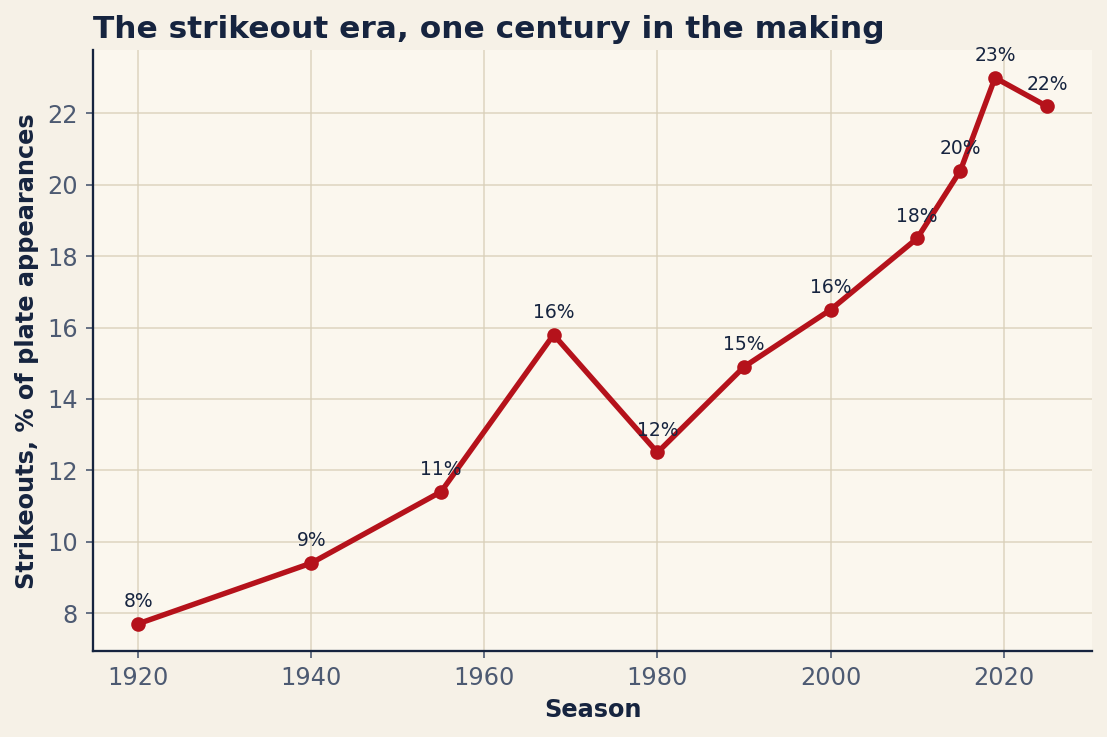
Start with the raw number, because the raw number is staggering. In 1920, the first full season of the live-ball era, hitters struck out in just 7.7% of their plate appearances — fewer than three times per team per game. By 2025 that rate had nearly tripled to 22.2%. No other fundamental rate stat in baseball has moved this far in one direction over the sport’s modern history. Batting average wanders inside a narrow band; home-run rates rise and fall with the era; the strikeout just climbs.
What makes the trend so unusual is how few real reversals it contains. The chart below tracks the league strikeout rate season by season, and the shape is less a roller coaster than a staircase. There is exactly one meaningful dip — the contact-minded 1970s and 1980s — and even that valley sits well above where the sport started.
The live ball and the swing for damage
The first push came from Babe Ruth and the idea he made respectable. Before Ruth, the prevailing wisdom held that a big uppercut was a sucker’s swing — choke up, slap the ball, run. Ruth demonstrated that one man swinging for the fences could out-produce a whole lineup of slap hitters, and the strikeouts that came with the big cut were simply the cost of doing business. The trade was worth it, and hitters slowly noticed.
The drift was gradual but relentless. By 1940 the league rate had reached 9.4%; by 1955 it was 11.4%. None of these were alarming numbers on their own, which is exactly the point — each generation accepted a little more swing-and-miss than the last in exchange for a little more thump, and the baseline quietly ratcheted upward. The strikeout was becoming not a character flaw but a tactic.
1968 and the year of the pitcher
Then the pendulum swung hard toward the mound. The 1960s belonged to pitchers — bigger, taller, throwing from a 15-inch hill against a strike zone that had been expanded in 1963 — and the trend peaked in 1968, the famous “Year of the Pitcher.” Bob Gibson posted a 1.12 ERA, Carl Yastrzemski won a batting title at .301, and the league struck out in 15.8% of trips, nearly 5.91 times per team per game. Offense had cratered, and the strikeout rate had reached a height that would have looked science-fictional to a hitter from 1920.
The response was structural. After 1968 the rules-makers lowered the pitching mound from 15 inches to 10 and shrank the strike zone, deliberately tilting the field back toward the hitter. It worked, and it is the single clearest cause of the only sustained decline in our chart. Strikeouts fell and stayed lower for a generation.
The contact decades — and the surge that followed
The 1970s and 1980s are the contact era, the brief stretch when the line bent downward. By 1980 the league rate had fallen all the way back to 12.5%, roughly 4.81 strikeouts per team per game — lower than it had been in 1968 by a wide margin. Artificial turf rewarded ground balls and speed, manufactured runs were in vogue, and a generation of contact-first hitters made putting the ball in play fashionable again. For a moment it looked as though the strikeout’s long rise might have a natural ceiling.
It did not. From that 1980 trough the rate resumed climbing and never looked back: 14.9% in 1990, 16.5% in 2000, 18.5% in 2010. Expansion in the 1990s thinned the pitching talent pool in some respects, but it also accelerated the relentless rise in velocity, and the modern bullpen began deploying a parade of fresh, high-octane arms that no lineup ever got comfortable against. Every structural change seemed to favor the strikeout.
Three true outcomes and the air-or-nothing game
The final accelerant was philosophical. Once front offices internalized that a walk was nearly as good as a single and a home run was worth more than three of them, the logical hitter stopped caring about contact for its own sake and started optimizing for damage on the balls he did hit. Launch angle became a coaching obsession; the strikeout became an acceptable byproduct of a swing built to do real harm. This is the three-true-outcomes approach — walk, homer, or whiff — and it carried the league rate to 23.0% in 2019, an astonishing 8.81 strikeouts per team per game.
The peak itself came just after, and it is worth stating precisely because it is often mis-stated. The highest league strikeout rate on record is 23.4%, set in the pandemic-shortened 60-game 2020 season; the highest in a full-length season is 23.2% in 2021. Both sit above 2019, and the table below carries all three rows so the claim can be checked rather than taken on trust — the same three seasons appear in the K% column of our shift-ban piece.
The 2025 figure of 22.2% sits a little over a point below that high-water mark, which is less a reversal than a plateau near the top of the mountain; the rate has ticked down modestly but remains within shouting distance of the record. The strikeout is now simply the texture of the game. It is the same air-or-nothing logic that has reshaped offense across the board, the natural endpoint of a sport that decided contact was a means and not an end.
The arms race on the other side
None of this happens without the pitchers, and the pitchers have never been more dangerous. Average fastball velocity has climbed steadily into the high-90s; breaking balls spin faster and break later; pitch-design labs engineer sweepers and splitters specifically to generate empty swings. A reliever today routinely throws gas that would have been the hardest pitch in the league a generation ago, and he does it for one inning before the next one does the same. Hitters optimizing for damage and pitchers optimizing for whiffs are pulling in the same direction — both make contact rarer.
The longer arc of all this — how the dead-ball game became the modern launch-angle game — is the through-line we trace in our history of baseball through modern metrics. The strikeout is the cleanest single number for watching that whole transformation unfold.
The numbers, era by era
Here are the landmark seasons laid side by side — the rate of climb is easier to feel in a table than in prose, and the lone dip in 1980 stands out as the exception that proves the rule. The 2020 and 2021 rows are included precisely because they hold the peak; a table that jumped from 2019 to 2025 would let a reader mistake 2019 for the record.
| Season | K% | K / team-game |
|---|---|---|
| 1920 | 7.7 | 2.95 |
| 1940 | 9.4 | 3.68 |
| 1955 | 11.4 | 4.39 |
| 1968 | 15.8 | 5.91 |
| 1980 | 12.5 | 4.81 |
| 1990 | 14.9 | 5.67 |
| 2000 | 16.5 | 6.46 |
| 2010 | 18.5 | 7.06 |
| 2015 | 20.4 | 7.71 |
| 2019 | 23.0 | 8.81 |
| 2020 | 23.4 | 8.68 |
| 2021 | 23.2 | 8.68 |
| 2025 | 22.2 | 8.36 |
The bottom line
A strikeout used to be a hitter’s small humiliation, rare enough to remark on. Now it is the cost of admission to a game built on damage, thrown by pitchers built to miss bats. From 7.7% in 1920 to 22.2% in 2025, with only the brief contact-era reprieve of the 1970s and 1980s to interrupt the climb, the whiff has gone from oddity to inevitability. Whether the plateau just below the 2020–21 high of 23.4% holds, or the rules-makers intervene the way they did in 1969, is the open question — but the century-long trend has earned the benefit of the doubt.
Sources & Further Reading
- Historical strikeout data: MLB.com (MLB Stats API, league AL/NL hitting). Numbers retrieved September 2026; computed for this article from that source.
- Baseball-Reference — season-by-season league batting totals and the 1968–69 rule changes.
- Society for American Baseball Research (SABR) — background on the live-ball shift and the Year of the Pitcher.