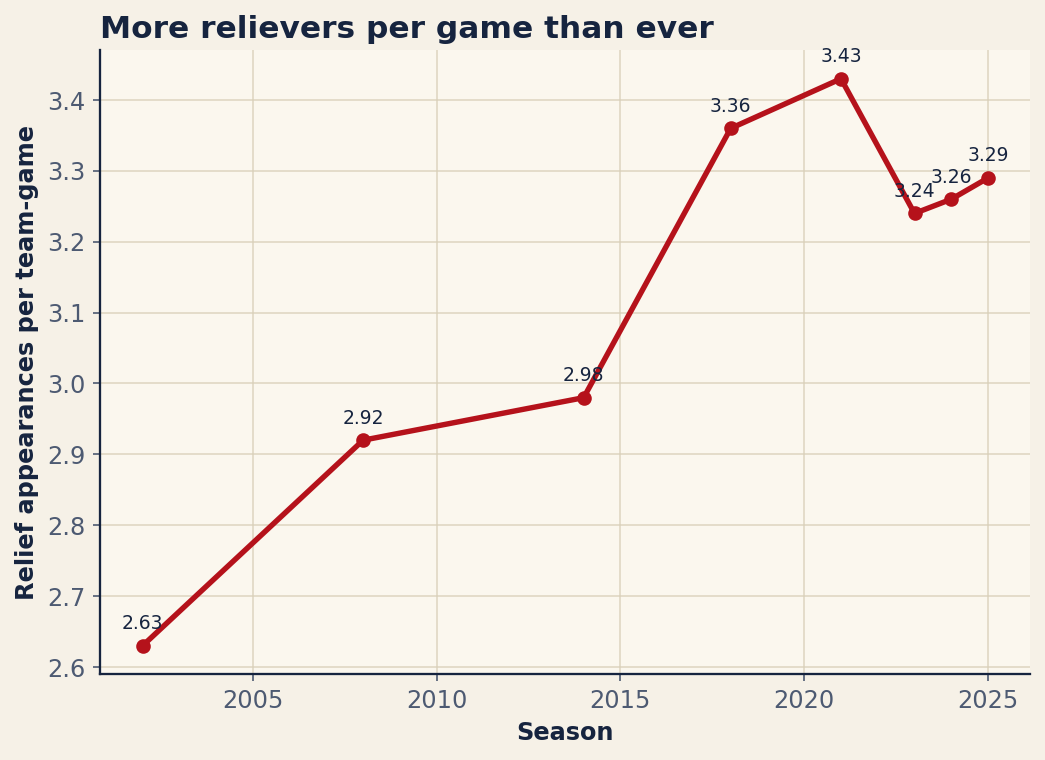
For most of baseball history, the starting pitcher was the story and the bullpen was the cleanup crew — a place you sent the arms who couldn’t finish what they started. That hierarchy is gone. In 2025 the average team handed the ball to 3.29 relievers per game, and relief pitchers accounted for 76.7% of all pitching appearances. The bullpen isn’t the supporting cast anymore; on most nights it does the majority of the work.
The shift didn’t happen overnight, and — this is the part that gets missed — it didn’t happen forever. The numbers below come from exact appearance counts pulled from the MLB Stats API, not innings estimates, and they tell a story with two acts: a long climb, then a deliberate pullback.
The numbers, season by season
Start with the long view. In 2002, teams used 2.63 relievers per team-game, and relief outings made up 72.4% of all pitching appearances. By 2014 that had crept to 2.98 and 74.8%. Then the curve steepened: 3.36 in 2018, and a peak of 3.43 in 2021, when more than three-quarters of every staff’s appearances — 77.4% — came from the pen.
What makes these figures trustworthy is how they’re built. Each is an exact count: total relief appearances divided by total starts, season by season, with no estimating and no rounding of innings into outings. When the table says 20,868 total appearances in 2025 against 17,611 in 2002, those are head counts, not models. The trend is real, and so is the reversal at the end of it.
Why the bullpen swallowed the game
Four forces pushed relief usage up, and they reinforced one another. The first is specialization. As front offices learned to quantify platoon splits, the value of bringing in a left-hander to face a dangerous left-handed bat — or a sidearming righty to erase a righty — became impossible to ignore. A manager who could win three or four individual matchups a night by swapping arms was leaving runs on the table if he didn’t.
The second is the times-through-the-order penalty. Hitters improve dramatically the more often they see a pitcher within a game; a starter facing a lineup for the third time is, on average, a meaningfully worse pitcher than the same man in the first inning. Once that penalty was measured and believed, the logic was brutal: pull the starter before the third trip through the heart of the order and replace him with a fresh arm the hitters haven’t timed.
A reliever throwing 15 pitches at maximum effort is a fundamentally different problem for a hitter than a starter pacing himself across 95.
The third force is velocity. A reliever who knows he’ll throw one inning can empty the tank on every pitch; a starter has to ration. As bullpens filled with arms touching the high-90s in short bursts, the gap between “tiring starter” and “fresh flamethrower” widened, and managers reached for the phone earlier and earlier.
The fourth is the opener — the tactic, popularized in the late 2010s, of starting a reliever for one inning to neutralize the top of the order before handing off to a bulk pitcher. It blurred the line between “starter” and “reliever” entirely and nudged appearance counts higher, because a game with an opener is, by definition, a game with one more pitching change.
The table tells on the plateau
Here is where the data complicates the tidy “bullpens take over forever” narrative. After the 2021 peak of 3.43, the number didn’t keep climbing. It fell.
| Season | Relievers / game | Relief app. % | Total appearances |
|---|---|---|---|
| 2002 | 2.63 | 72.4 | 17611 |
| 2008 | 2.92 | 74.5 | 19012 |
| 2014 | 2.98 | 74.8 | 19321 |
| 2018 | 3.36 | 77.1 | 21197 |
| 2021 | 3.43 | 77.4 | 21541 |
| 2023 | 3.24 | 76.4 | 20630 |
| 2024 | 3.26 | 76.5 | 20693 |
| 2025 | 3.29 | 76.7 | 20868 |
Relievers per game dropped to 3.24 in 2023, then ticked gently back to 3.26 in 2024 and 3.29 in 2025 — still well below the peak. The relief-appearance share followed the same shape, sliding from 77.4% to 76.4% and recovering only to 76.7%. After two decades of nearly uninterrupted growth, the trend simply stopped and partially reversed. That plateau is not random.
The rules that bent the curve
Two rule changes, both phased in around 2020, directly targeted the most extreme bullpen behavior. The first is the three-batter minimum: with limited exceptions, a pitcher who enters a game must face at least three batters or finish the half-inning. That single rule gutted the economics of the one-out specialist. The old play — summon a lefty for exactly one left-handed hitter, then immediately swap him out — became illegal. Matchup churn that used to add a pitching change or two per game was legislated away.
The second is the active-roster pitcher limit. Capping the number of pitchers a team may carry (13, with a temporary expansion to 14 in some windows) removed the deep benches that made hyper-specialization possible in the first place. You cannot deploy a different arm for every batter if you are only allowed to dress thirteen of them; the roster math forces starters to go a little longer and relievers to cover more than a single hitter.
Put those two rules together and the post-2021 dip reads cleanly. The league didn’t fall out of love with relievers — 3.29 per game and 76.7% of appearances is still a bullpen-dominated sport by any historical standard. What changed is that the most fragmentary, matchup-by-matchup usage got priced out by rule, trimming the peak back toward a sustainable equilibrium.
What it means going forward
The honest read of these numbers is that bullpen usage has matured rather than retreated. The structural reasons relievers took over — the order penalty, velocity, platoon advantages — are all still true and aren’t going anywhere. The rules didn’t repeal that logic; they capped its most extreme expression. The result is a stable plateau in the high-3.2s rather than a runaway climb toward four or five relievers a night.
For anyone building or reading staff-usage models, that distinction matters. A forecast that simply extends the 2002–2021 trend line would overshoot 2025 badly. The realistic expectation is a sport that keeps leaning on its bullpen heavily but no longer escalates — a game where roughly three relievers a night, covering about three-quarters of all appearances, is just the steady state.
The bottom line
Relief pitching went from 72.4% of appearances in 2002 to a 77.4% peak in 2021, then settled to 76.7% by 2025 as the three-batter minimum and roster caps curbed the most extreme matchup churn. The headline isn’t “bullpens are still taking over” — it’s that they already did, and the rulebook has since drawn the line on how far it goes. The pen runs the modern game; it just no longer runs away with it.
Sources & Further Reading
- Appearance counts: MLB.com (MLB Stats API season pitching-appearance totals). Numbers retrieved June 2026; computed for this article from that source.
- Baseball-Reference — historical relief-usage and games-finished leaderboards.
- SABR — research on the times-through-the-order penalty and the rise of the opener.