The 2026 regular season ended on September 27, and this page now holds its final numbers: every club’s record, run differential and Pythagorean luck, pulled from the MLB Stats API on October 5, 2026. Through the summer it was a living snapshot, re-rendered from the standings as games were played. With the schedule complete it is a record. It stays as published, and if MLB ever revises a figure, our refresh flags it for a re-check instead of quietly changing the page.
Three results stand out. The Brewers finished with the best record in baseball (103–59) and the best run differential (+214). The Astros won the American League West at 81–81, the fewest wins by any division winner in a full season since divisional play began in 1969. And records strayed further from run differentials than in any full season from 2010 through 2025, and no club this season strayed further than the Tigers, who outscored their opponents by 71 runs and finished 76–86.
The final standings
Six clubs won their divisions: the Brewers (NL Central, 103–59), the Dodgers (NL West, 100–62), the Rays (AL East, 98–64), the Braves (NL East, 94–68), the Guardians (AL Central, 85–77) and the Astros (AL West, 81–81). The Brewers and Dodgers were the only teams to win 100 games. The Rays finished with the American League’s best record and took the East by 4.5 games over the Yankees. The Guardians won the Central by a game over the White Sox, and the Astros won the West by a game over the Rangers (80–82).
| Club | W–L | Pct. | GB | Run diff. | Postseason |
|---|---|---|---|---|---|
| AL East | |||||
| Rays | 98–64 | .605 | — | +86 | Division winner |
| Yankees | 93–68 | .578 | 4.5 | +138 | Wild card |
| Red Sox | 87–75 | .537 | 11.0 | +78 | Wild card |
| Orioles | 79–82 | .491 | 18.5 | −21 | |
| Blue Jays | 79–83 | .488 | 19.0 | −46 | |
| AL Central | |||||
| Guardians | 85–77 | .525 | — | +11 | Division winner |
| White Sox | 84–78 | .519 | 1.0 | +56 | Wild card |
| Twins | 77–85 | .475 | 8.0 | −58 | |
| Tigers | 76–86 | .469 | 9.0 | +71 | |
| Royals | 69–93 | .426 | 16.0 | −120 | |
| AL West | |||||
| Astros | 81–81 | .500 | — | −32 | Division winner |
| Rangers | 80–82 | .494 | 1.0 | −46 | |
| Mariners | 76–86 | .469 | 5.0 | −58 | |
| Athletics | 64–98 | .395 | 17.0 | −238 | |
| Angels | 62–100 | .383 | 19.0 | −97 | |
| NL East | |||||
| Braves | 94–68 | .580 | — | +116 | Division winner |
| Phillies | 88–74 | .543 | 6.0 | +15 | Wild card |
| Marlins | 80–82 | .494 | 14.0 | +3 | |
| Nationals | 77–85 | .475 | 17.0 | +6 | |
| Mets | 74–88 | .457 | 20.0 | −32 | |
| NL Central | |||||
| Brewers | 103–59 | .636 | — | +214 | Division winner |
| Cubs | 89–73 | .549 | 14.0 | +147 | Wild card |
| Pirates | 82–80 | .506 | 21.0 | +28 | |
| Cardinals | 77–85 | .475 | 26.0 | −29 | |
| Reds | 75–87 | .463 | 28.0 | −160 | |
| NL West | |||||
| Dodgers | 100–62 | .617 | — | +201 | Division winner |
| Padres | 91–71 | .562 | 9.0 | +41 | Wild card |
| D-backs | 86–76 | .531 | 14.0 | +9 | |
| Giants | 65–97 | .401 | 35.0 | −91 | |
| Rockies | 58–104 | .358 | 42.0 | −192 | |
Twelve clubs reached the postseason: the six division winners plus three wild cards in each league, the Yankees, Red Sox and White Sox in the American League and the Padres, Cubs and Phillies in the National. The White Sox made the longest climb into the field: 41–121 in 2024, 60–102 in 2025, and 84–78 with a wild card this year. This page stops at the regular season. The standings feed it reads does not carry postseason results, so none are reported here.
The final luck table
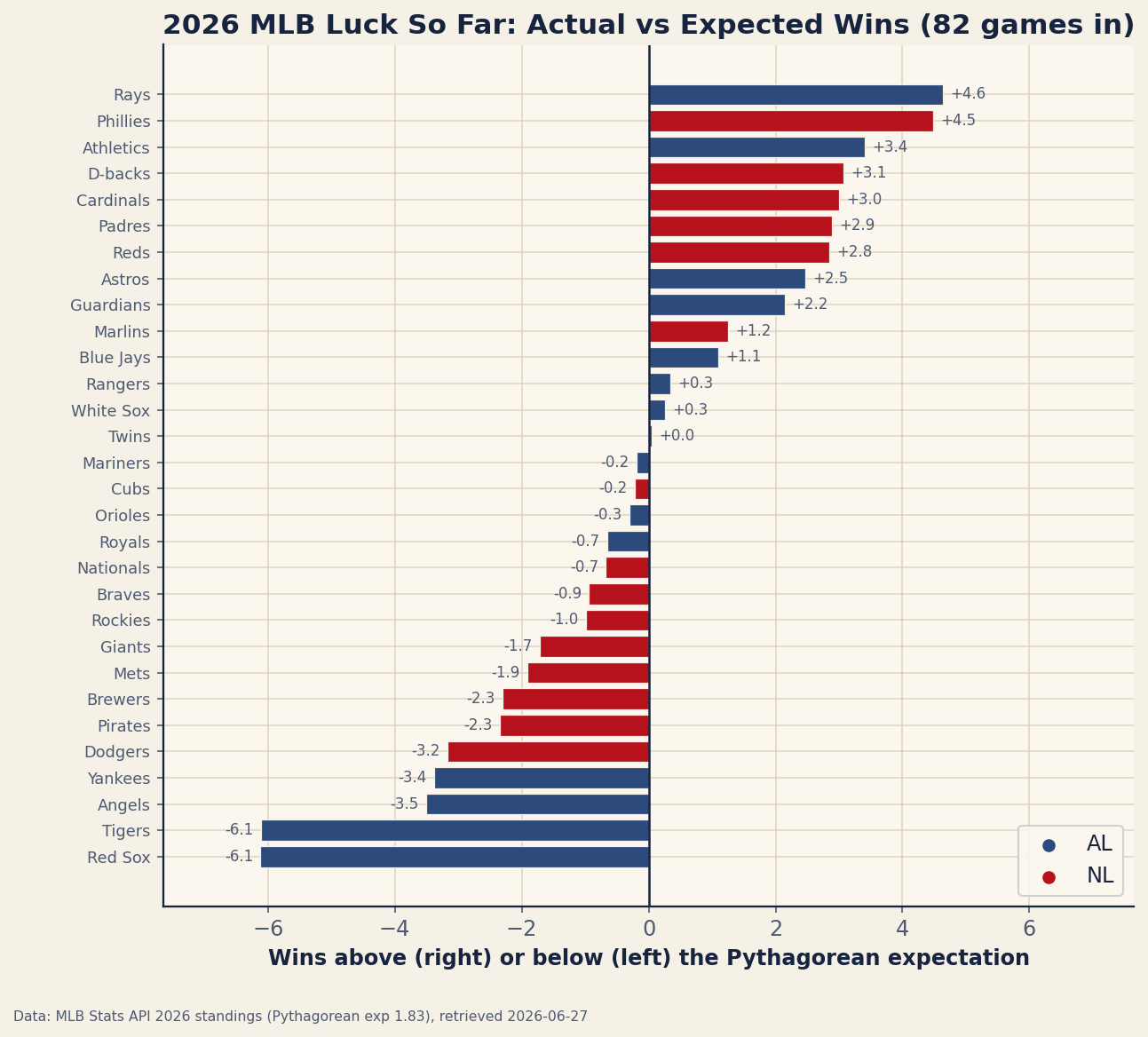
Run differential, runs scored minus runs allowed, is the better measure of how good a team was, because it does not care how the runs were bunched. The Pythagorean formula turns it into an expected winning percentage, RS1.83 / (RS1.83 + RA1.83); multiplied by games played, that gives expected wins. The gap between actual and expected wins is what we call luck. It is mostly the timing of runs and the record in close games, and in our tests it has not carried from one season to the next.
| Club | Lg | W–L | Run diff. | Expected W | Luck |
|---|---|---|---|---|---|
| Reds | NL | 75–87 | −160 | 65.2 | +9.8 |
| Rays | AL | 98–64 | +86 | 90.2 | +7.8 |
| Padres | NL | 91–71 | +41 | 85.3 | +5.7 |
| Phillies | NL | 88–74 | +15 | 82.6 | +5.4 |
| Athletics | AL | 64–98 | −238 | 59.8 | +4.2 |
| D-backs | NL | 86–76 | +9 | 81.9 | +4.1 |
| Rangers | AL | 80–82 | −46 | 76.1 | +3.9 |
| Astros | AL | 81–81 | −32 | 77.8 | +3.2 |
| Blue Jays | AL | 79–83 | −46 | 75.9 | +3.1 |
| Guardians | AL | 85–77 | +11 | 82.2 | +2.8 |
| Twins | AL | 77–85 | −58 | 75.4 | +1.6 |
| Mariners | AL | 76–86 | −58 | 74.8 | +1.2 |
| Orioles | AL | 79–82 | −21 | 78.4 | +0.6 |
| Braves | NL | 94–68 | +116 | 93.5 | +0.5 |
| Brewers | NL | 103–59 | +214 | 102.5 | +0.5 |
| Royals | AL | 69–93 | −120 | 69.2 | −0.2 |
| Cardinals | NL | 77–85 | −29 | 78.1 | −1.1 |
| Marlins | NL | 80–82 | +3 | 81.3 | −1.3 |
| Pirates | NL | 82–80 | +28 | 83.8 | −1.8 |
| Dodgers | NL | 100–62 | +201 | 101.9 | −1.9 |
| White Sox | AL | 84–78 | +56 | 86.5 | −2.5 |
| Yankees | AL | 93–68 | +138 | 95.5 | −2.5 |
| Red Sox | AL | 87–75 | +78 | 89.9 | −2.9 |
| Mets | NL | 74–88 | −32 | 77.7 | −3.7 |
| Nationals | NL | 77–85 | +6 | 81.5 | −4.5 |
| Cubs | NL | 89–73 | +147 | 94.9 | −5.9 |
| Rockies | NL | 58–104 | −192 | 64.4 | −6.4 |
| Giants | NL | 65–97 | −91 | 71.6 | −6.6 |
| Angels | AL | 62–100 | −97 | 70.8 | −8.8 |
| Tigers | AL | 76–86 | +71 | 88.6 | −12.6 |
Start with the two ends of the table. The Reds won 75 games on a run differential of −160 that projects 65.2, about 9.8 wins of good fortune. The Tigers won 76 where +71 projects 88.6, a shortfall of 12.6.
The Tigers’ arithmetic, step by step: they scored 723 runs and allowed 652. 7231.83 / (7231.83 + 6521.83) = .5471, and .5471 × 162 games = 88.6 expected wins, against 76 actual. MLB’s own expected record, which the same standings feed carries, matches ours to the nearest win for all 30 clubs. It has the Tigers at 89–73 and the Reds at 65–97.
What 162 games settled
One floor fell, and one held
On September 21 we priced the AL West race with the Rangers leading at 78–78. That simulation gave Texas a 71.8 percent chance of the title and Houston 28.1 percent, and it put 52.4 percent on a champion with 81 wins or fewer and 18.0 percent on one finishing below .500. Houston won it at exactly 81–81, a game ahead of Texas.
That broke one floor and left the other standing. Before this season the fewest wins by a division winner in a full season was 82, shared by the 1973 Mets (82–79) and the 2005 Padres (82–80). The Astros set a new low and are the first full-season division winner without a winning record. No champion has finished below .500: the only first-place club with a losing record in the divisional era is still the 1994 Rangers, 52–62 when the strike ended that season. Houston was also outscored by 32 runs, the second-largest deficit for a full-season division winner after the 2005 Padres’ 42, and every club in the AL West finished with a negative run differential, the champion included.
Run differential and the standings disagreed about two titles
In four divisions the champion also had the best run differential. In the other two it did not. The Yankees outscored their opponents by 138 runs, which projects 95.5 wins; the Rays did it by 86, which projects 90.2; the Rays won the East by 4.5 games. In the Central the Guardians won at +11, the third-best run differential in their own division, behind the Tigers (+71) and the White Sox (+56).
The Tigers missed the postseason with the American League’s fourth-best run differential, and five of the twelve postseason clubs finished with a smaller one: the White Sox (+56), Padres (+41), Phillies (+15), Guardians (+11) and Astros (−32). That part is not new. In three of the four previous seasons under the 12-team format, 2023, 2024 and 2025, at least one club with a better run differential than Detroit’s missed the postseason.
The widest luck spread since at least 2010
Across all 30 clubs, the standard deviation of luck in 2026 was 4.90 wins. We computed the same figure for every full season from 2010 through 2025 from the API’s final standings, leaving out the 60-game 2020 season, and none was wider; 2021 came closest at 4.83. The Tigers’ −12.6 is the largest shortfall among the 480 team-seasons in that span. The previous largest was last season’s: the 2025 White Sox finished 10.9 wins under their expectation at 60–102. At the other end, the Reds’ +9.8 ranks sixth, and the 2021 Mariners hold the top spot at +14.2.
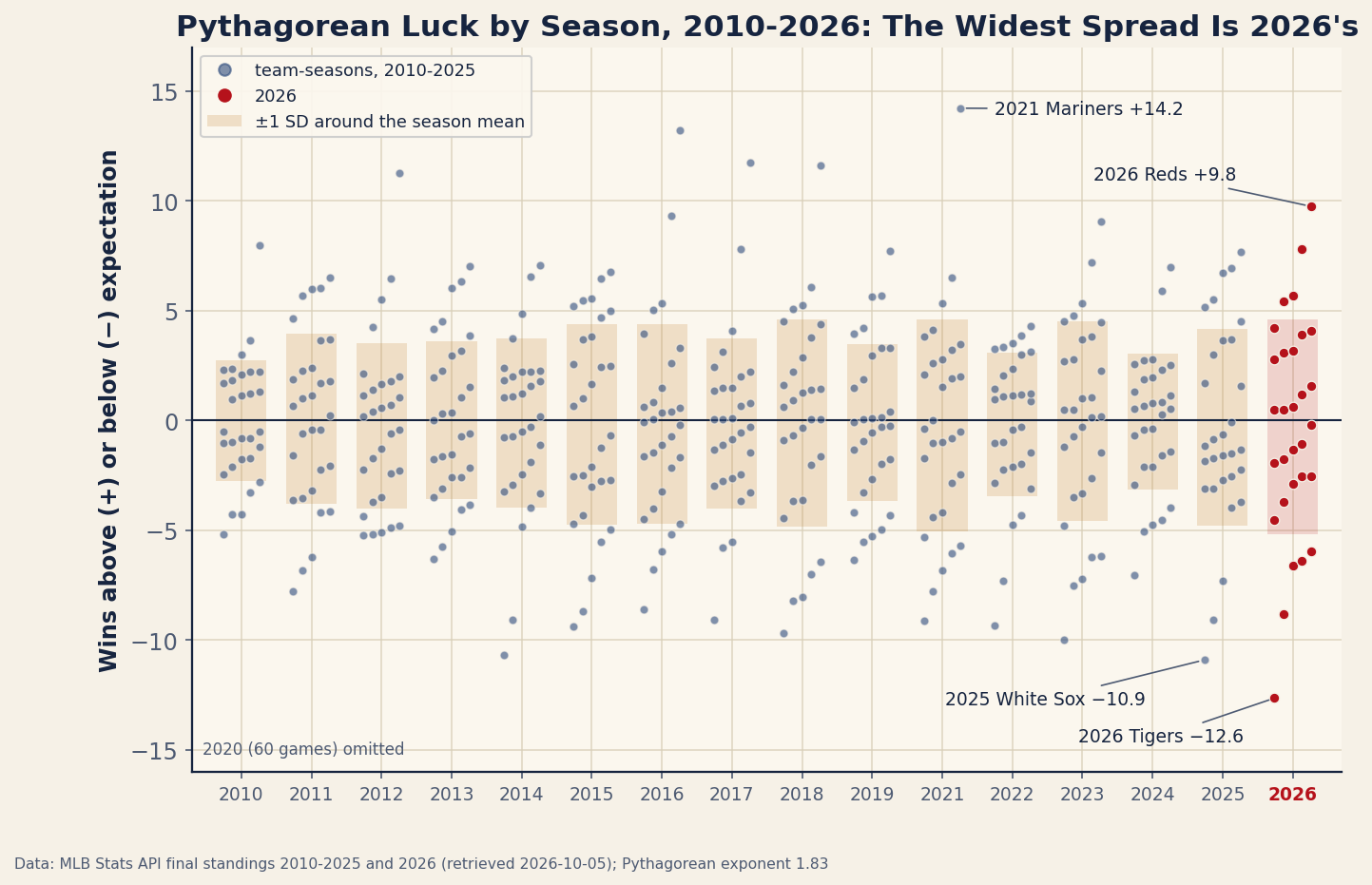
None of this makes the Tigers secretly great or the Reds secretly bad in a way that lasts. When we tested whether clubs carry their luck from one season to the next, across 90 season pairs from 2021 to 2024, the correlation was +0.003 (the full test). For next season, expected wins have been the better guide: across the same 90 pairs, Pythagorean winning percentage predicted the following year’s record at r = 0.57, against 0.54 for the actual record (the comparison).
The July parity finding did not hold
In July we measured 2026 as the most bunched season in at least a decade: a spread of team winning percentage (the population standard deviation) of .0620 after about 97 games, under all nine final seasons in our 2015–2024 file (.0633 to .0963), and an estimated .0531 once the extra noise of a partial season was taken out. The full season finished at .0670. That is tighter than seven of those nine finals and tighter than 2025 (.0711), which makes these the most bunched final standings since 2016. It is wider than 2015 (.0633) and 2016 (.0651). The standings spread out after July by more than the adjustment allowed for.
The offense gap stayed closed
Also in July, the gap between baseball’s best and worst offense had narrowed to 1.52 runs a game, the narrowest of the five seasons we compared. It finished narrower still. The Cubs scored 5.25 runs a game and the Blue Jays 4.00, a gap of 1.25, narrower than any full season from 2010 through 2025. The closest was 2012, at 1.39.
Scoring finished where September left it
The league scored 21,769 runs in 2,429 games, 8.96 a game for both teams combined. That is up from 8.89 in 2025 and 8.79 in 2024, below 2023’s 9.23, and level with 2016. It is also the reading our run-environment piece had through September 4.
The honest caveats
- Luck is a label, not a verdict. The Pythagorean gap is mostly sequencing and close-game noise, but some of it can be real: a bullpen that keeps winning or losing close games moves it. Read it as a prior to regress toward.
- The exponent matters at the margin. At the site’s 1.83, 2026’s luck spread is the widest of the sixteen seasons, and it stays the widest at every exponent from 1.74 to 2.00 in steps of 0.01, though at 2.00 its margin over 2021 is three thousandths of a win. The Tigers’ shortfall is the largest at every one of those exponents.
- “Since at least 2010” is the window, not all of history. Our luck, spread and scoring comparisons use final standings from 2010 through 2025. Whether a club fell further short of its run differential before 2010 is a question these files cannot answer. The division-winner comparisons reach back to 1969.
- One flag in the feed contradicts the standings. On October 5, 2026 the API’s
divisionChampfield read true for the Phillies, who finished second in the NL East, six games behind the Braves. We take division winners from the division rank, which agrees with the won-lost records. - Regular season only. The postseason is not covered here, because the feed this page reads ends with the regular season.
Reproduce it
The standings and the regular-season schedule are pulled from the MLB Stats API by data_layer/build_mlb_2026.py into data_layer/mlb_2026_standings.json. The schedule check found no regular-season game left to play and 2,429 games played, matching the standings. When a pull confirmed the season complete, data_layer/refresh_mlb_2026.py froze the file as the season’s final record (a dated copy is data_layer/mlb_2026_standings_2026-10-05.json), redrew the luck chart with charts/chart_mlb_2026_luck.py and rendered this page from data_layer/mlb_2026_final.template.html. Later builds re-pull and compare against the frozen file but never overwrite it.
The history is data_layer/standings_2010_2025.json, one API call per season (data_layer/build_standings_2010_2025.py). It matches our Retrosheet-derived season file, data_layer/september_form_2010_2025.json, on wins, losses and runs for 478 of 480 team-seasons; the two that differ are the 2016 Cubs and Pirates, whose official tie game the API counts in runs scored and allowed. Division winners since 1969 come from data_layer/division_winners.json, scoring rates from data_layer/run_environment_2015_2025.json, and which clubs reached the 2022–2025 postseasons from the same season file. charts/chart_mlb_2026_final.py draws the history chart and checks every figure on this page against those files: 74 checks, all passing.
Sources & further reading
- MLB Stats API (statsapi.mlb.com): the 2026 regular-season standings and schedule and the 2010–2025 final standings, retrieved 2026-10-05; division winners 1969–2025, retrieved 2026-09-21.
- Retrosheet game logs 2010–2025, used here only as the cross-check described above. The information used here was obtained free of charge from and is copyrighted by Retrosheet. Interested parties may contact Retrosheet at www.retrosheet.org.
- The in-season pieces these numbers answer: The .500 Division Winner, The Parity Check, The Offense Gap Collapses and the 2026 run environment.
- Method: Is Beating Your Run Differential a Skill?, Run Differential Predicts Next Year Better Than Wins Do and How Many Runs Does a Win Cost?