Here is a piece of sabermetric folklore worth testing: a team’s run differential tells you more about its future than its actual won-lost record does. The claim sounds almost paradoxical — how can a made-up “expected” record beat the real one? — but it falls straight out of the data. Across four recent seasons, a team’s Pythagorean win percentage (built from runs scored and allowed) predicts next year’s record better than its actual win percentage does: r = 0.57 versus 0.54. It’s a small edge, but it’s real and it’s the right direction, and the reason why is the whole point.
The test
For every team we lined up two numbers from one season against its record the following season: its actual winning percentage, and its Pythagorean winning percentage — the record it “should” have had given its runs scored and allowed (RS^1.83 / (RS^1.83 + RA^1.83)). Then we asked which one correlates more strongly with next year’s actual record across all 90 consecutive-season pairs from 2021 through 2024. Whichever wins is the better crystal ball.
The exhibit
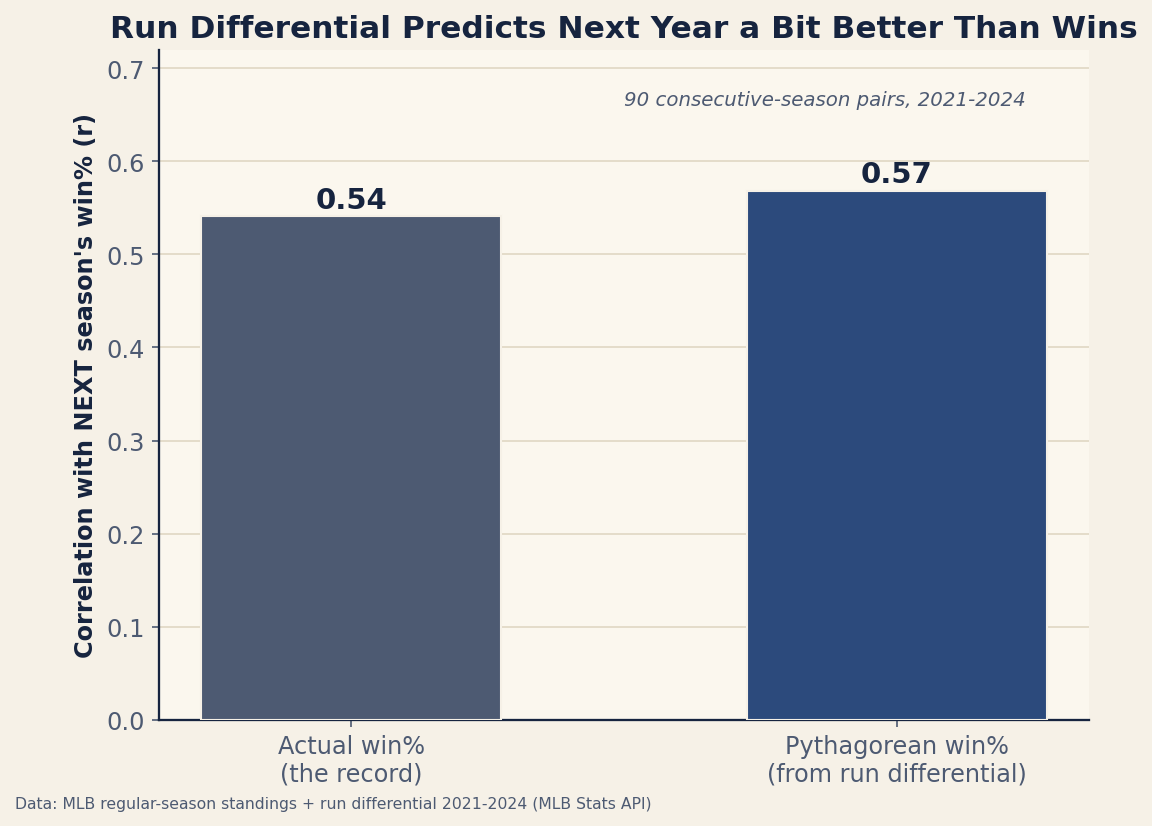
The Pythagorean bar is the taller one. It’s not a blowout — 0.57 versus 0.54 — but the run-differential-based estimate beats the literal record at forecasting the future, every time you’d expect a fluke to favor one or the other. The team’s real won-lost record is the worse predictor of its own future record.
Why the “fake” record wins
The resolution is that a season’s record is part skill and part luck, and the luck doesn’t carry over. The biggest source of that luck is timing — how a team’s runs happened to be distributed across games. Bunch your runs into blowout wins and waste them in close losses and you’ll finish below your run differential; cluster them efficiently and you’ll finish above it. That over- or under-performance is mostly luck, and luck is, by definition, not repeatable.
Run differential strips that timing luck out. By looking at how many runs a team scored and allowed rather than when, the Pythagorean record captures the part of the season that reflects true quality and discards the part that was a coin flip. So when you carry it forward a year, you’re forecasting from the signal instead of the signal-plus-noise. The actual record, by contrast, drags last year’s good or bad timing luck into a prediction where it has no business being — which is exactly why it’s the worse forecaster.
A worked intuition
Picture two 85-win teams. One had a +90 run differential (a true ~91-win team that underperformed by six on bad timing); the other had a +5 differential (a true ~82-win team that overperformed by three on good timing). Their records are identical, so actual win% predicts the same future for both. But they are not the same team: the first is genuinely better and is the better bet to win more next year, while the second is likely to slide back. Pythagorean record sees that difference; the standings don’t. Multiply that across ninety team-seasons and you get the 0.57-versus-0.54 edge — the predictable consequence of forecasting from differential instead of wins. It’s the same logic behind why last year only weakly predicts this year at all: records regress, and run differential regresses less.
Where this read has limits
- The edge is small, and the sample is modest. 0.57 vs 0.54 over 90 pairs from four seasons is a real but narrow gap; a different window would wobble the exact numbers. The direction (Pythagorean > actual) is the robust, repeatable finding documented across far longer histories — not the third decimal.
- Neither number is a great predictor. Both top out near 0.55 because so much changes between seasons — roster turnover, injuries, aging. Run differential is the better baseline, not a strong one; real projection systems beat both by adding player-level forecasts.
- Run differential has its own luck. It removes timing luck but not everything — a team’s RS/RA still carry some sequencing and health noise. It’s a better signal, not a pure one.
- Park and league context. Raw runs aren’t park-adjusted; the Pythagorean estimate inherits whatever distortion the run environment adds, which a fuller model would strip out.
The takeaway
If you want to know how good a team really was — and how good it’s likely to be next year — look at its run differential, not its record. The Pythagorean “expected” win percentage beats the actual one at predicting the future (0.57 to 0.54) for a simple reason: it keeps the signal (how many runs you scored and allowed) and throws away the noise (the lucky timing that turned those runs into a few extra or fewer wins). The standings are what happened; run differential is closer to what was real — and what’s real is what carries over.
Reproduce it
The records and run totals are bundled in data_layer/standings_multiseason.json (2021–2024, MLB Stats API). For each consecutive-season pair, compute year-N actual win% and Pythagorean win% (from RS/RA), then correlate each with year-(N+1) win%. The comparison is regenerated by charts/chart_pythag_predicts_next.py. No network at build time, nothing hand-entered.
Sources & Further Reading
- Standings and run differential 2021–2024: bundled
data_layer/standings_multiseason.json, from the MLB Stats API, charted bycharts/chart_pythag_predicts_next.py. - The Pythagorean win expectation is Bill James's; the “Pythagorean record predicts better than actual record” result is a long-standing finding in the sabermetric literature (Baseball Prospectus, et al.).
- Related: Does last year predict this year? and the luckiest and unluckiest teams — the carryover and the timing luck this piece builds on.