Since 2020, every regular-season extra inning has started with a runner already on second base. The rule is now written into the Official Baseball Rules as 7.01(b)(2): “Each half-inning following the ninth inning will begin with a runner on second base.” We pulled the line score of every extra-inning game from 2010 to yesterday to see what it has actually done. It did what it was built to do, and more completely than we expected: extra-inning games now end in the 10th nearly three times in four.
The reason to look now is the next rule down. Rule 7.02(g) says the placed runner “does not apply to any Wild Card Series, Division Series, League Championship Series or World Series games.” The postseason starts next week, and a tied October game goes back to the old extra innings, the kind the regular season has not seen for six years.
How the numbers were built
For 2010 through 2025 we used Retrosheet’s game logs, which carry each team’s runs inning by inning. For 2026 we pulled every final regular-season game through September 23 from the MLB Stats API with its line score. Every game’s line score had to add up to its final score or the build stopped; none failed. An extra-inning game is one where the visitors batted in more than nine innings.
Two seasons are left out of the comparison. In 2020 and 2021 doubleheader games were scheduled for seven innings, so an eighth inning could be an extra inning, and 2020 was also a 60-game season. That leaves a clean “before” of 2010–2019, 2,127 extra-inning games out of 24,296, and a clean “after” of 2022–2025, 842 out of 9,719. The 2026 season to date adds 208 more.
One number did not move, and should not have: the share of games that reach extras at all was 8.75% before and 8.66% after. The rule only starts once the ninth is over, so it cannot change how often the ninth ends tied.
What the runner did to the 10th inning
Without the runner, the visitors scored in the top of the 10th in 24.9% of extra-inning games, averaging 0.46 runs. With the runner, they score 57.0% of the time and average 1.08. A runner on second with nobody out is worth more than a run on its own before anyone swings, which is roughly what the run expectancy table would predict.
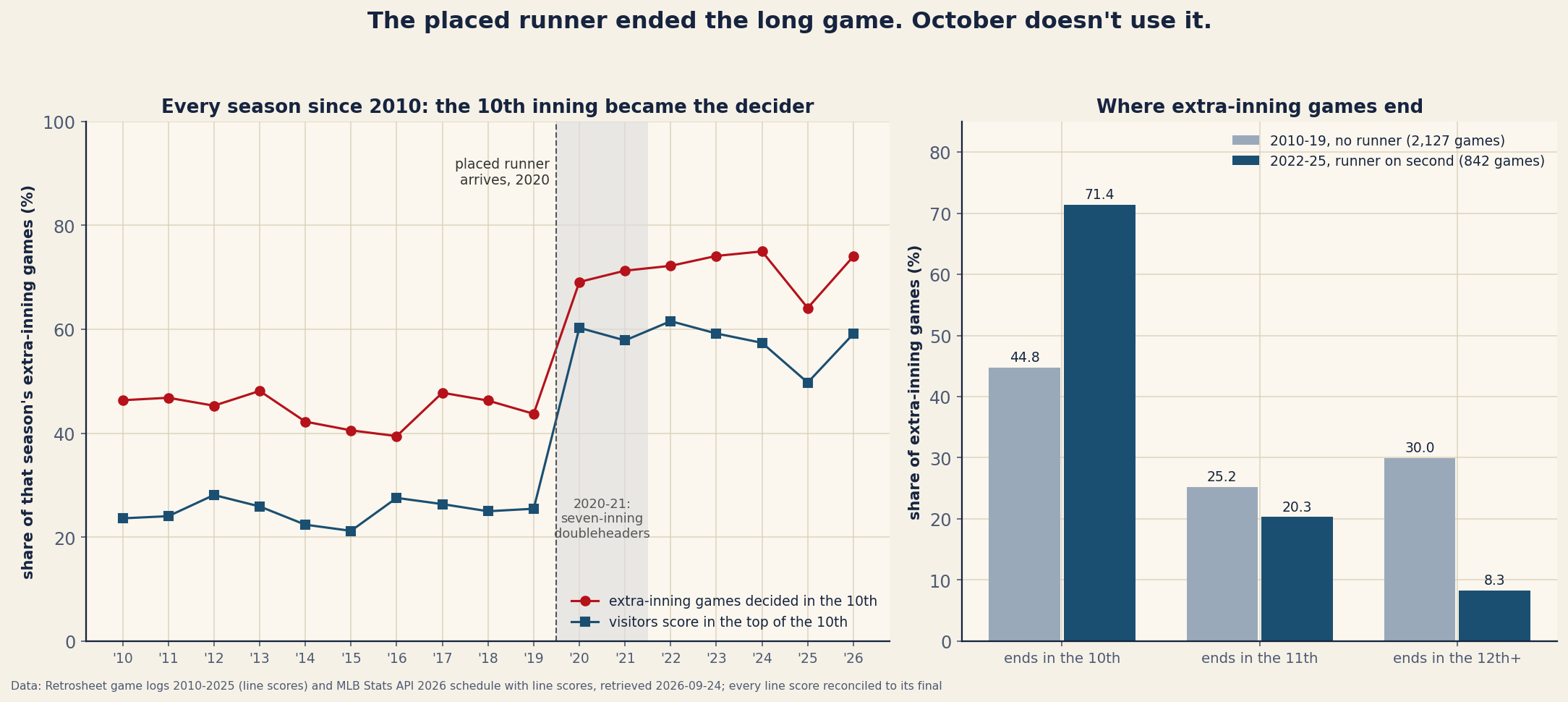
The chart shows where the change happens, and it is one step, not a trend. Top-of-the-10th scoring peaked at 28.1% in any season before 2020 and has not fallen below 49.8% in any season since. That lowest post-rule season is 2025, the one year the runner looked tamer, when only 64.1% of extra-inning games ended in the 10th. This year is back at 74.0%.
The long game is nearly gone
The result is shorter extra innings. Before the rule, an extra-inning game took 2.22 extra innings on average and 30.0% of them reached the 12th. With the runner it takes 1.40, and only 8.3% reach the 12th. The longest game in the before period went 20 innings; the longest since 2022 went 15, and this season’s longest has been 13.
| Era | Extra-inning games | Ended in the 10th | In the 11th | 12th or later | Extra innings per game |
|---|---|---|---|---|---|
| 2010–19 | 2,127 | 44.8% | 25.2% | 30.0% | 2.22 |
| 2022–25 | 842 | 71.4% | 20.3% | 8.3% | 1.40 |
| 2026 to Sept. 23 | 208 | 74.0% | — | — | 1.37 |
The bottom of the 10th, by the target
The more interesting question is what the home team does once it knows the number. Split the bottom of the 10th by what the visitors scored in the top half:
| Visitors scored | Era | Games | Home walked it off in the 10th | Home lost in the 10th |
|---|---|---|---|---|
| 0 | 2010–19 | 1,598 | 29.1% | — |
| 0 | 2022–25 | 362 | 60.2% | — |
| 1 | 2010–19 | 289 | 9.7% | 78.9% |
| 1 | 2022–25 | 254 | 26.0% | 43.7% |
| 2 or more | 2010–19 | 240 | 4.2% | 92.1% |
| 2 or more | 2022–25 | 226 | 10.2% | 81.0% |
Before the rule, a scoreless top of the 10th was the usual outcome, three games in four, and the home side then won in its half 29.1% of the time. Now a scoreless top half is the minority, and when it happens the home side, starting with its own runner on second, walks it off 60.2% of the time. A one-run deficit used to be close to fatal in the 10th (the home side lost 78.9% of those games on the spot); now it loses 43.7% of them there, wins 26.0% and sends 30.3% to the 11th.
The home-field edge that did not appear
The standard objection to the rule is that it favours the home team, which bats second and knows exactly what it needs. The table above shows why that sounds plausible. The totals say it has not happened. Home teams won 51.7% of extra-inning games in 2010–19 and 50.6% in 2022–25. The change is 1.1 points in the other direction, with a standard error of 2.0, which is nothing. This season they have won 49.0% of them.
The edge the home side does lose is the one it always lost in extra innings. Across all games, home teams won 53.5% before the rule and 53.0% after; in extra innings, less. Knowing the target helps in the bottom half, but the visitors get their own runner on second in the top half, and over 842 games the totals come out about even.
The bottom line
The placed runner did exactly one big thing: it made extra innings short. Games that reach the 10th are now decided there 71.4% of the time instead of 44.8%, and the 12-inning game has gone from almost a third of extra-inning games to under a tenth. It did not tilt them toward the home team.
Which is why October is worth watching. The rule does not apply in the postseason, so a tied playoff game goes back to the 2010–19 conditions in this article: visitors scoring in the top of the 10th about a quarter of the time, fewer than half of games decided in that inning, and three in ten going 12 or more. After six regular seasons of short extras, a long October game will feel stranger than it used to. For how the rest of the postseason differs from the regular season, see why the best team loses in October.
Sources & Further Reading
- Retrosheet game logs, 2010–2025, for every game’s line score. The information used here was obtained free of charge from and is copyrighted by Retrosheet. Interested parties may contact Retrosheet at www.retrosheet.org.
- MLB.com: the MLB Stats API schedule with line scores for 2026, retrieved 2026-09-24, and the 2026 Official Baseball Rules (Rules 7.01(b)(2) and 7.02(g)).
- Built by
data_layer/build_extra_innings_2010_2026.py; every figure is recomputed and checked bycharts/chart_extra_innings.py.