There is no Game 163 anymore. Since 2022, two teams that finish with the same record don’t play for the division or the wild card; the tie is settled on paper, head-to-head record first, and the loser of that arithmetic goes home having never lost a decisive game. That changes what a September standings page means. A tie is not a coin flip waiting to happen. It already belongs to somebody, and in most cases it has belonged to them for weeks. As of the morning of September 10 — 2,195 games played, 235 left — we rebuilt every 2026 season series from the game log to find out who.
The answer is that the tiebreakers are mostly decided, and a surprising share of them are decided against the team currently ahead. Of the 25 two-team pairings inside the live races, 16 already have an owner. Eight of those 16 belong to the team that is behind in the standings. The Guardians hold the American League’s last playoff seat and would lose a tie to both of the teams closest behind them. The Rangers, two games back in the AL West, cannot tie their way past Houston at all. And the National League’s last seat, a half-game race with the season series level at 5–5, will be settled by a three-game set that is, by the schedule’s accident, the final series of the year.
The rule, and the arithmetic it changes
The procedure, checked this week against two independent current write-ups: a two-club tie goes first to the better head-to-head record, then to the better intradivision record, then to intraleague splits (the two sources we used phrase the later tiers slightly differently — one says the full intraleague record, the other the intraleague record after the All-Star break — so this piece stops at tier two, which is where every 2026 case we found resolves anyway). Ties of three or more clubs use a separate round-robin procedure that we are not modelling. The one thing that no longer exists is the extra game.
The consequence is simple and, we think, under-appreciated. The standings say the Rangers are two games behind the Astros. But Houston won the season series 9–4, and it’s over. If the two finish level, Houston wins the division. So Texas cannot merely catch Houston; it must finish strictly ahead. A chaser without the tiebreaker is effectively half a game farther back than the standings show, and a leader without it is half a game closer to the pack. Every gap in the tables below should be read with that half-game attached to whichever side doesn’t own the tie.
Eight races, eight owners
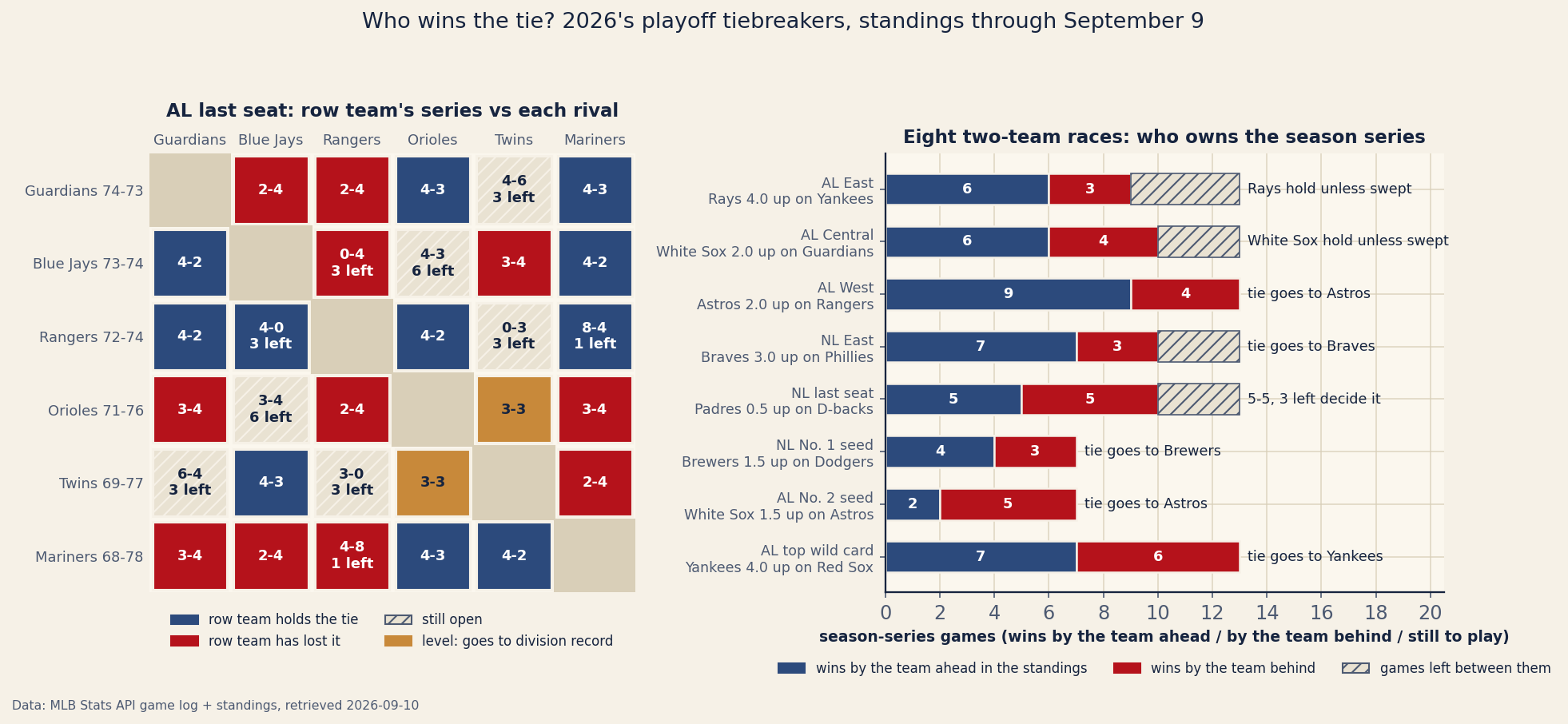
Run down the right panel. Two of the four live division races are already owned outright: the Astros over the Rangers (9–4, finished) and the Braves over the Phillies (7–3 with three left — Philadelphia can sweep this weekend’s series in Atlanta and still lose the season set 7–6). The other two are held by the leader unless the chaser sweeps what’s left: the Rays lead the Yankees 6–3 with four games remaining in Tampa Bay on September 22–24, one of them a doubleheader, and the White Sox lead the Guardians 6–4 with three to play September 14–16. Every one of those is a 13-game series, which matters for a reason we’ll get to.
The seeding rows are the ones nobody prints. The Brewers own the tie with the Dodgers for the National League’s top seed, 4–3 in a series that is over, with Milwaukee a game and a half up. The AL’s second bye is a closer thing: the White Sox sit 1.5 games ahead of the Astros for it, but Houston took the season series 5–2, so the team that’s ahead is the team that loses the tie. And the Yankees, four games clear of the Red Sox for the top wild card and the home field that comes with it, also own the 7–6 season series — the one pair on the board where the standings margin and the tiebreaker both point the same way and neither is in doubt.
The AL scrum: the seat’s holder loses every tie that matters
The left panel is the race for the American League’s last seat, the one pacing historically cheap: the Guardians at 74–73, then the Blue Jays 1.0 back, the Rangers 1.5, the Orioles 3.0, the Twins 4.5, the Mariners 5.5. Read the Guardians’ row. Cleveland lost the season series to Toronto 2–4 and to Texas 2–4, and both are finished. Those are the two teams within a game and a half of its seat. It holds the tie over Baltimore and Seattle (4–3 each), which are the teams three and five and a half games back, and against Minnesota it trails 4–6 with three games to play this weekend — a sweep is the only way it takes that one. A holder that must finish strictly ahead of its two nearest pursuers is holding less than a game.
Now read the Rangers’ row. Texas has clinched the tiebreaker over four of its five scrum rivals: the Guardians 4–2, the Blue Jays 4–0 with three still to play (Toronto can sweep that series September 18–20 and lose it 4–3), the Orioles 4–2, and the Mariners 8–4 with one game left tonight. The lone exception is Minnesota, against whom the Rangers are 0–3 with three left on the season’s final weekend. So the same team that cannot touch its division leader directly is, in the wild-card race, the best-positioned tie-owner in the league. Texas is a game and a half from the seat in the standings and, in every plausible two-team finish, exactly that far and no farther.
Seven of the scrum’s fifteen pairings run against the team currently ahead in the standings. The Blue Jays are ahead of the Rangers and have lost the tie; ahead of the Twins (3–4, finished) and have lost it; the Orioles are ahead of both the Twins and the Mariners and hold neither; the Twins are a game ahead of the Mariners and lost that series 2–4. The only open matter of any size is Blue Jays–Orioles, 4–3 Toronto with six games left, split across this weekend and September 21–23. That series is the single largest block of unresolved tiebreaker in baseball, and it sits between two teams the standings have already separated by two games.
Why a division tie never reaches tier two — and which ties do
Here is the structural fact that fell out of the game log and that we did not expect. Under the balanced schedule, every pair of division rivals plays exactly 13 games — all 60 division pairs in 2026, no exceptions in the data. Thirteen is odd. A 13-game series cannot end level, so a two-team division tie is always broken at the head-to-head tier and the intradivision record is never consulted. The same holds for Padres–D-backs, which is a division pair racing for a wild card: 5–5 today, three games left, and whoever wins two of those three owns the tie. There is no scenario in which that race reaches the second tiebreaker.
Same-league teams in different divisions play six or seven, and the six-game series is where tier two lives. The three level series in our 25-pair audit are all six-game sets: Orioles–Twins 3–3, Padres–Pirates 3–3, D-backs–Pirates 3–3. Each falls to intradivision record, which changes nightly, so what follows is as of September 9 and nothing more: Minnesota is 24–25 inside the AL Central and Baltimore 17–26 inside the AL East, so the Twins own that tie; San Diego is 22–17 in the NL West and Arizona 28–18, against Pittsburgh’s 22–21 in the Central, so both hold the tie over the Pirates. The Rangers–Twins case is the odd one: Texas is 0–3 with three left, so even a sweep only levels the series at 3–3 — and on today’s division records (Texas 23–28, Minnesota 24–25) the tie would still go to Minnesota. The Rangers can’t win that tiebreaker on the field this month; they need their division record to pass the Twins’ too.
A worked example: Texas’s two games are really two and a half
Astros 74–72, Rangers 72–74, sixteen games each. Give Houston an unremarkable 8–8 finish: 82–80. Under the old rules, Texas going 10–6 — also 82–80 — would have forced a 163rd game. Under the current rule, 82–80 apiece is a Houston division title, because 9–4 is 9–4. Texas needs 11–5 (83–79) to clear an 8–8 Houston by one game. That is the half-game, made concrete: against the same Astros finish, the tiebreaker converts a required 10–6 into a required 11–5, and 11–5 over sixteen games is a .688 clip from a team playing .493 ball.
The Yankees’ version runs the other way, and it’s the most interesting live scenario on the board. New York trails Tampa Bay by four with four head-to-heads left. Sweep them — and only sweep them — and two things happen at once: the gap closes by exactly four, to a tie at 87–62 apiece if nothing else moves, and the season series flips to 7–6 New York. The sweep doesn’t just tie the division; it wins it outright, with no help from anyone. A 3–1 series leaves the Yankees two back and the tie in Tampa Bay’s hands at 7–6. It’s the same all-or-nothing shape as Philadelphia’s weekend, except that Philadelphia’s sweep produces a tie at 85–64 that Atlanta wins 7–6. Same three-game gap, same sweep, opposite outcome, and the only difference is who won the games already played.
And Cleveland’s: Guardians 74–73, Blue Jays 73–74, fifteen games each. If both go 8–7, Cleveland finishes 82–80 to Toronto’s 81–81 and keeps the seat by one. If Toronto goes 9–6 instead, it’s 82–80 apiece, and the seat is Toronto’s on the 4–2 season series. One extra Blue Jays win doesn’t produce a tie; it produces a Toronto playoff berth.
Limitations, stated plainly
This is a map of two-team ties. Three-way ties — and the AL scrum could produce one — use a different procedure, and we have not modelled it. Tier two is stated as of September 9; intradivision records move with every division game, and each team has several left, so the Orioles–Twins, Pirates and Rangers–Twins calls above are current, not final. The later tiers are described inconsistently by the two sources we used; nothing here depends on them. Race membership is a bright line we chose: division pairs within four games, seat races within 5.5 games of the holder, plus the three seeding pairs named — move the line and the 25, the 16 and the eight all move with it (drop the cutoff to 4.5 games and the Mariners, party to two of the adverse pairs, fall out of the audit). The dataset drops one duplicate feed entry (a suspended June 16 Giants–Braves game the API lists on both its original and its resumption date) and 27 postponed entries superseded by their makeups; every club’s reconstructed record matches the official standings exactly, which is the check that catches that sort of thing. Finally, none of this is a forecast. Sixteen games of pure noise between two evenly matched teams carry a standard deviation of about 2.8 games (√(16/2)), so every gap on this board is within variance’s reach — the yardstick piece makes that argument in full. What the tiebreaker changes is not the odds of a close finish but what a close finish is worth, and to whom.
Reproduce it
Three frozen files, one pull: data_layer/head_to_head_2026_2026-09-10.json (every decided 2026 game through September 9, folded into season series and division/league splits per club, built by data_layer/build_head_to_head_2026.py from the MLB Stats API’s schedule feed and reconciled club-by-club against the standings), mlb_2026_standings_2026-09-10.json, and remaining_schedule_2026-09-10.json. The chart-and-verification script charts/chart_tiebreakers_2026.py recomputes every figure in this piece from those files — every series, every clinch, the 25-pair partition, the eight adverse pairs, the 13-game and six-game structure across all 435 pairs, the tier-two records, the game dates, and the worked examples — and asserts them against the published values, 100-plus checks in all. The elimination arithmetic these ties feed is in the magic-number piece; the remaining opponents’ strength is priced here.
Sources & Further Reading
- MLB Stats API — schedule (game log) and standings endpoints (public), retrieved 2026-09-10; bundled as the three dated files named above.
- MLB.com — the league’s official tiebreaker procedures live in its rules glossary; the procedure quoted here was cross-checked on 2026-09-10 against Wikipedia’s tie-breaking procedures entry and a Yahoo Sports explainer dated August 17, 2026, which agree on the first two tiers and on the absence of tiebreaker games.
- The Head-to-Head Endgame — which September races can still move directly; this piece is what those games are worth when they end level.
- The Playoff Bar — what the AL’s last seat is pacing to cost, tiebreakers excluded.
- The 2026 Playoff Races, Priced — how far variance alone can move each race.
- The Magic Number, Explained — the clinch and elimination countdowns.